
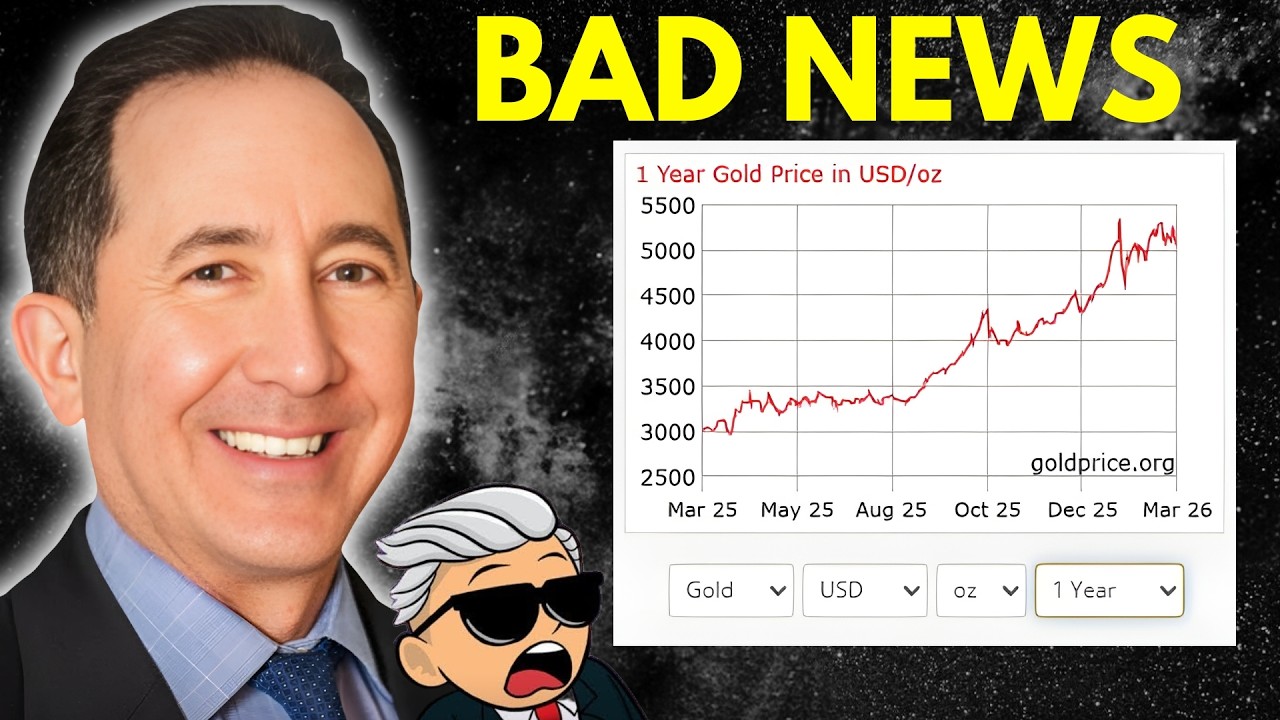
The video is an interview centered on Peter Bookvar’s macro view: he argues the Iran-linked energy shock is now driving market volatility, while AI mega-cap tech and private credit were already showing fragility. He thinks gold and silver are consolidating after a parabolic run, sees a broader commodity bull market, and believes higher energy prices make Fed rate cuts unlikely.
Watch on YouTube ›Get the market thesis, key claims, assets, contradictions, and follow-up questions from any financial video — then unlock a version personalized to your portfolio, watchlist, and favorite speakers.
This transcript opens with a promotional silver giveaway, then shifts into an interview between host Ivan and guest Peter Bookvar, the chief investment officer at Onepoint BFG Wealth Partners. The discussion begins with the market reaction to a geopolitical shock: Bookvar says the Iranian war/disruption has produced an oil shock, with knock-on effects across natural gas, fertilizer, sulfur, ammonium, travel, and other supply chains. He frames the key issue as duration and says the fate of the global economy depends on which side blinks first. Bookvar then argues that markets were already weakening before the shock. In his view, the AI tech trade had started to lose momentum, especially among hyperscalers whose heavy capital spending is compressing free cash flow. …
Near term, the trade is about energy-driven inflation shock and headline volatility: that favors caution on risk assets and keeps gold/silver reactive rather than trending cleanly. Watch for follow-through in oil and any sign the market is repricing rate-cut odds lower.
Over the next few months, the base case is a rotation regime: AI infrastructure leaders may lose relative momentum while value, internationals, and commodity-linked assets gain durability if energy stays firm. The key confirmation is whether free-cash-flow pressure and inflation persistence keep broadening beyond one-off geopolitics.
Structurally, the transcript argues for a more commodity-sensitive macro regime where energy shocks, inflation, and capital intensity matter more than the last decade’s asset-light tech leadership. If that regime holds, the long-run winners shift toward real assets, selective value, and businesses that benefit from or can pass through higher input costs.
The Iran-linked conflict is causing an oil shock with broader supply-chain knock-on effects.
Bookvar explicitly links the war to oil disruptions and spillovers into gas, fertilizer, sulfur, ammonium, and travel.
The duration of the Iran shock is the key variable, and the global outcome depends on which side blinks first.
He says the economic fate depends on duration and escalation/settlement dynamics.
The AI tech trade was already losing momentum before the geopolitical shock.
He says markets were splintering and investors were revaluing hyperscalers before discussing Iran.
What craziness has developed in the markets since you were last on?
Peter cites the oil shock from the Iran-Iraq conflict disrupting supplies of oil, natural gas, fertilizer, and more via the Strait, plus disruption in travel. He notes the market was already splintering before this with the AI tech trade losing steam, private credit concerns growing, and fragility building.
What does it mean when BlackRock halts people from taking their money out of private credit?
Peter says he always felt that private credit and private equity were a bad match for retail investors who lack the long time horizon. He predicts this leads to more redemption requests, less net new money, and banks re-evaluating lending to private credit. Private credit will have to deal with existing portfolios and find other ways to raise money, while banks may try to regain market share.
Why are gold and silver stalling right now despite the war breaking out in the Middle East?
Peter believes gold and silver are still digesting the late 2025/early 2026 parabolic spike, which takes months to consolidate. He notes choppiness: some days gold trades with a stronger dollar, other days as a safety trade. Silver faces conflicting forces — if the situation is negative for global growth that hurts industrial demand, but on gold-rally days silver bounces. He believes a base is being formed and eventually they'll trade like critical minerals in a full-fledged commodity bull market.
Unlock the full claims, asset map, scores, related transcripts, follow-up questions, and AI chat — shaped around your portfolio, watchlist, favorite speakers, and risks.
