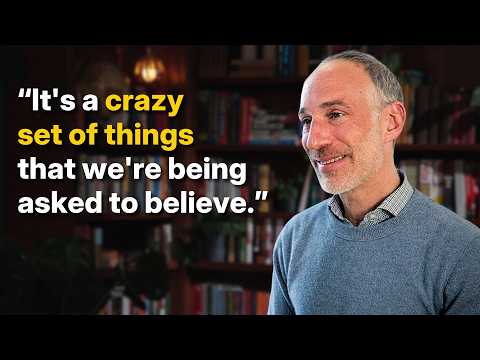
Dwarkesh interviews Harvard ancient-DNA professor David Reich about a new preprint arguing that natural selection in Europe and the Middle East was much more active over the last 10,000 years than older work suggested, with a particularly sharp intensification in the Bronze Age. Reich also develops a speculative alternative model for Neanderthal/modern-human relationships and broader human origins.
Watch on YouTube ›Get the market thesis, key claims, assets, contradictions, and follow-up questions from any financial video — then unlock a version personalized to your portfolio, watchlist, and favorite speakers.
This episode is a long-form interview with David Reich focused on ancient DNA, selection, and human history. Reich explains that the central motivation of his work is to move beyond population history and use much larger ancient-DNA datasets to detect actual biological change over time. He argues that earlier work underestimated selection because sample sizes were too small and because migration/admixture dominated allele-frequency changes, masking weaker selection signals. The main empirical claim is that natural selection has not been quiescent over the last 10,000–18,000 years in Europe and the Middle East. Using a new method that combines a relatedness model with selection statistics across roughly 22,000 people and 10 million genomic positions, the team identifies hundreds of strong selection signals and thousands more probable ones. …
For the immediate setup, the main catalyst is the new preprint and whether its Bronze Age-selection claims hold up under scrutiny. The tactical risk is overextending the findings into provocative trait or intelligence conclusions before replication.
Over the next few months, the base case is a live debate over whether human adaptation in Europe and the Middle East accelerated during the Bronze Age, with immune and metabolic traits the most defensible evidence. The thesis strengthens if independent ancient-DNA studies recover the same inflection after ancestry correction.
The structural implication is that human evolution over the Holocene was far more active than the old near-stasis story, with repeated environmental shocks reshaping trait frequencies. If this framing holds, ancient DNA will increasingly be used to reconstruct adaptation as well as migration, and our picture of human history will stay much more dynamic and admixture-heavy than a simple tree model suggests.
Ancient DNA now has enough sample size to detect biological change over time, not just population history.
Reich says the field was historically good at migrations and mixture, but not biology, mainly because sample sizes were too small until recently.
Most allele-frequency change over the last 10,000 years is due to migration and genetic drift, but a small fraction reflects directional selection.
He gives a quantitative breakdown, saying 98% of frequency change is from other factors and that selection is still detectable.
Natural selection appears to intensify during the Bronze Age and Iron Age, rather than peaking at the start of farming.
This is one of the central findings: stronger signals around 5,000 to 2,000 years ago than in the earlier Neolithic transition.
How do you describe what it is that you study?
Reich says he is a geneticist who studies human history and how ancient people relate to people living today.
Can you give me a little bit of context on what we're talking about today?
Reich explains that the field succeeded at reconstructing human history but has struggled to infer biological change because ancient-DNA sample sizes were too small until recently.
Why are frequency changes especially interesting?
He says frequency changes reveal biologically important variants that responded to environmental shifts such as agriculture, domestication, or climate change.
Unlock the full claims, asset map, scores, related transcripts, follow-up questions, and AI chat — shaped around your portfolio, watchlist, favorite speakers, and risks.