
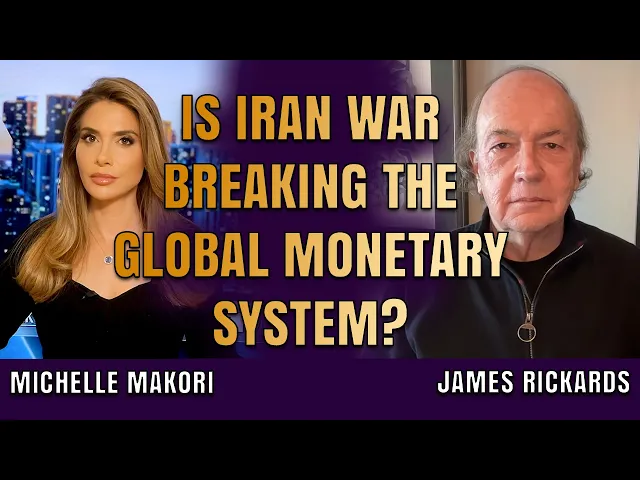
Michelle Makori interviews Jim Rickards about the Iran ceasefire, the Strait of Hormuz, oil flows, gold, and the global monetary system. Rickards argues the ceasefire terms are inconsistent, the military objectives were overstated, the dollar remains dominant as a reserve system, and gold still has a plausible path to $10,000 by year-end.
Watch on YouTube ›Get the market thesis, key claims, assets, contradictions, and follow-up questions from any financial video — then unlock a version personalized to your portfolio, watchlist, and favorite speakers.
This is a geopolitical-and-macro interview centered on the Iran conflict and its implications for oil, gold, the dollar, and global liquidity. Michelle Makori opens by describing the ceasefire, conflicting US/Iran messaging, market reactions in oil, equities, gold, and silver, and then brings in Jim Rickards for a geopolitical and market read. Rickards says the ceasefire is directionally good but argues the two sides are not actually aligned on terms. He repeatedly emphasizes that Iran and the US are describing different agreements: Iran wants sanctions relief, an end to attacks on its allies, and toll-based control over the Strait of Hormuz, while Trump’s version demands free passage, uranium-enrichment limits, and surrender of highly enriched uranium. …
Near term, the trade is headline volatility: any sign the ceasefire holds supports risk assets and pressure on oil, while any breakdown keeps oil, freight, and defensive hedges bid. Gold stays tactically supported as long as the ceasefire remains fragile and the Strait of Hormuz is a live risk.
Over the next few weeks, the more likely path is not normalization but a messy stop-start negotiation that leaves energy markets and liquidity conditions strained. Confirmation would come from sustained passage through Hormuz and actual convergence on sanctions/enrichment; failure there argues for higher oil, weaker cyclicals, and stronger gold.
Structurally, the bigger regime question is not a yuan replacement for the dollar but whether reserve demand keeps migrating toward gold as trust in financial and geopolitical guarantees erodes. The conflict reinforces a world where hard assets, not alternative fiat currencies, gain relative appeal.
The US and Iran are not actually aligned on the ceasefire terms and have not directly negotiated.
Rickards says both sides are stating different conditions and using Pakistan as intermediary.
The administration’s victory messaging on Iran is overstated and amounts to propaganda.
He argues military success was real in part, but the broader 'mission accomplished' framing is wrong.
Iran still retains missiles, drones, and enough military capability to avoid regime collapse.
He says launchers were hit, but not all missiles are gone and regime change has not occurred.
Wouldn't this conflict accelerate other countries saying, 'I'd rather have gold than dollars'?
Jim Rickards agrees it's absolutely right. He says you're not going to a yuan reserve currency — you can hit on the dollar but can't get away from it — and warns we may be walking into a global liquidity crisis.
In light of this conflict, where do you see gold ending this year?
Jim seems to begin responding before this excerpt cuts off to an ad break, so the full answer is not captured here.
Given that the two sides are so far apart, what is the likely next step in this dynamic?
Jim says the next step is they're talking, but notes US and Iran haven't met directly — they're going through Pakistan. He criticizes Witkoff and Kushner as dealmakers who aren't diplomats, says they lack trust and don't really know what they're doing in diplomatic talks, and warns that their pattern of announcing progress then bombing undermines trust.
Unlock the full claims, asset map, scores, related transcripts, follow-up questions, and AI chat — shaped around your portfolio, watchlist, favorite speakers, and risks.

