TranscriptAgent
Try it free
TRANSCRIPTAGENT.AI · transcript analysis

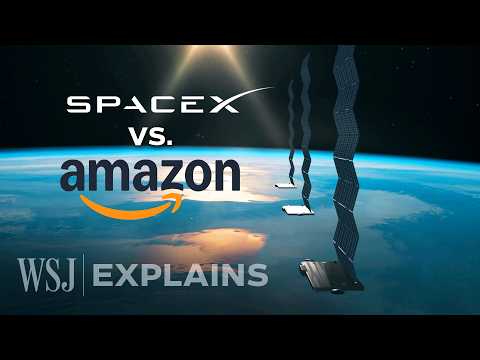
Amazon vs. SpaceX: The High-Stakes Battle for Space Internet | WSJ

Channel: The Wall Street Journal Published: 2026-05-11 11:30
The Wall Street Journal

WSJ argues that Amazon is a much smaller player than SpaceX in the race for low-Earth-orbit satellite internet, but that both are chasing a large and growing market. The piece explains why LEO satellites are attractive, why scale is hard, and why Starlink currently has the lead while Amazon is still building out Amazon LEO.

Watch on YouTube ›

Get the market thesis, key claims, assets, contradictions, and follow-up questions from any financial video — then unlock a version personalized to your portfolio, watchlist, and favorite speakers.

Detailed summary

This video frames the competition between Amazon and SpaceX as a scale contest in low Earth orbit (LEO) satellite internet. Amazon’s satellite business, Amazon LEO, has launched about 300 satellites, versus more than 7,000 authorized and roughly 12,000 launched by SpaceX for Starlink. The segment explains that LEO satellites sit much closer to Earth than traditional geostationary satellites, which improves performance because signals travel a shorter distance, but that this architecture requires many more satellites to provide broad coverage. The video contrasts LEO with older geostationary systems and notes that some operators still use geostationary orbit while SES is pursuing medium Earth orbit (MEO). …

🔒 The full detailed summary continues — read all of it free with an account. Read the full summary →

Main takeaways

  1. Amazon is still early in satellite internet, while SpaceX has a major first-mover and scale advantage.
  2. LEO offers better performance than higher orbits, but it is operationally expensive because coverage requires many satellites.
  3. The market opportunity is large enough to attract major players, governments, and new use cases beyond households.
  4. Demand growth depends on finding customers such as ships, airlines, and aircraft, not just home broadband users.
  5. Starlink is already a major revenue driver for SpaceX and is framed as central to the company’s IPO story.

Market read by horizon

Short term

SpaceX still owns the immediate lead in LEO internet, so the near-term setup is about launch cadence and whether Amazon can meaningfully close the deployment gap. The tactical risk is that the market overprices Amazon’s catch-up potential before actual satellites and revenue scale show up.

  • Amazon LEO is far behind Starlink in deployed scale, with roughly 300 satellites versus SpaceX’s ~12,000 launched.
Show more
  • The immediate tactical question is whether Amazon can accelerate launches enough to narrow the gap before the market fully prizes in Starlink’s lead.
  • Near-term investor attention is likely to stay on launch cadence, authorization approvals, and whether Amazon can prove commercial traction beyond the initial constellation.
Mid term

Over the next few months, the market should focus on whether LEO operators can prove recurring demand beyond consumer broadband, especially in maritime and aviation. If utilization improves, the growth narrative stays intact; if not, the valuation case becomes more fragile.

  • Over the next several weeks or months, the base case is continued expansion of LEO constellations as operators seek broader coverage and more commercial users.
Show more
  • Validation will come from utilization in non-household segments such as maritime, aviation, and other mobile connectivity markets.
  • The thesis weakens if operators fail to convert orbital scale into revenue growth or if the market concludes the economics require more capital than returns justify.
Long term

The transcript points to satellite internet as a durable new broadband infrastructure layer, with LEO as the main commercial battleground. In that regime, winners are likely to be firms that can sustain launch scale, capital intensity, and monetization across multiple end markets.

  • The structural implication is that satellite internet is becoming a durable global connectivity layer rather than a niche telecom product.
Show more
  • Scale and launch economics are likely to determine the winners, favoring vertically integrated operators with heavy capital and launch capacity.
  • The long-run regime may be a multi-orbit market, but LEO appears to be the core battleground because it best balances performance and coverage for broadband.
Unlock the full horizon read See the full short-term, mid-term, and long-term implications with confirmation and invalidation signals. Unlock horizon read

Key claims (1)

MIXED satellite internet competition Amazon vs. SpaceX

Amazon is far behind SpaceX in satellite deployment.

The transcript compares the number of launched satellites and emphasizes the gap.

Assets discussed (4)

Amazon LEO
BULLISH other

Amazon's satellite business is presented as a growing but still early-stage competitor in LEO.

SpaceX Starlink
BULLISH other

Starlink is framed as the dominant incumbent with far greater deployed scale and revenue relevance.

Unlock the full asset map (2 more) See all assets mentioned, their directional bias, and the exact reasoning. Unlock asset map

Speakers

SPEAKER Unknown narrator

Where this transcript pushes against consensus

  • The video cites a $1 trillion global broadband addressable market from a SpaceX executive, but that figure is broad and not directly tied to LEO-specific economics.
  • It assumes demand will expand enough to absorb thousands of satellites, but also notes that many households already have adequate internet and much of the Earth is ocean, which could constrain utilization.
  • The forecast that the LEO market could reach $108 billion by 2035 is presented as an estimate without showing the assumptions behind it.
  • The discussion implies Amazon and SpaceX are the main contenders, while other players and regulatory or pricing effects are not developed in depth.

Topics

low Earth orbit satellitesAmazon LEOSpaceX Starlinksatellite internet marketgeostationary orbitmedium Earth orbitsatellite broadband demandSpaceX IPO

Create your free research agent

Unlock the full claims, asset map, scores, related transcripts, follow-up questions, and AI chat — shaped around your portfolio, watchlist, favorite speakers, and risks.

  • Full claims and asset map
  • Personalized relevance to your watchlist
  • Follow-up questions you can track
  • Related transcripts from your workspace
  • AI chat about this video
Create your free research agent
TRANSCRIPTAGENT.AI