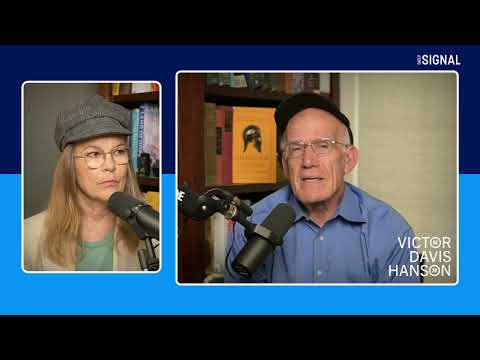
Victor Davis Hanson and Jack Fowler use the episode to contrast small-town localism with the perceived disorder of Los Angeles and California politics. The market-relevant portions are mainly fiscal: they discuss California’s tax base leaving the state, a large projected deficit, and the costs of what they frame as ideological governance failures.
Watch on YouTube ›Get the market thesis, key claims, assets, contradictions, and follow-up questions from any financial video — then unlock a version personalized to your portfolio, watchlist, and favorite speakers.
This transcript is primarily a long-form political and cultural commentary rather than a market or investing discussion. The opening portion is a personal reflection by Victor Davis Hanson about growing up in southwest Fresno County, the value of small-town familiarity, and how that shaped his preference for living outside Palo Alto even while working at Stanford. From there, the conversation pivots to Los Angeles politics, especially Karen Bass’s withdrawal from a mayoral debate, the debate performance of Spencer Pratt and Nithia Raman, and broader criticism of California governance. The most market-adjacent material centers on California’s fiscal position and the erosion of its tax base. …
Immediate setup is political and fiscal stress in California: continued headlines around LA, Bass’s debate exit, and the cited revenue leakage keep the negative narrative active. No direct trading catalyst is given, but the near-term risk is further confirmation of budget strain and policy dysfunction.
Over the next few months, the transcript’s base case is that California keeps losing taxable income and political credibility unless governance visibly improves. The key invalidation would be evidence that deficits stabilize, migration slows, or public-service failures ease rather than worsen.
The structural view is that residents and capital increasingly sort toward jurisdictions with lower taxes, better safety, and more accountable local governance. If that regime persists, high-cost blue states face lasting pressure on fiscal capacity, political legitimacy, and population retention.
Karen Bass withdrew from the next mayoral debate after being criticized for her prior performance.
The host says Bass announced she is withdrawing from the next debate and implies she was beaten in the earlier one.
California has lost $53 billion of adjusted gross income to other states.
A concrete fiscal outflow figure is cited as evidence of a weakening tax base.
If that outflow were taxed as ordinary income, California could lose over $50 billion in revenues.
The host and guest estimate a tax-revenue impact using the state income tax rate.
How much of California's lost income was taxed at capital gains versus ordinary income rates?
Victor Davis Hansen responds that if it was taxed at income level, California could lose over $50 billion in revenues. He does not provide a precise breakdown of capital gains vs. ordinary income.
Do you want to say anything about Bobby Cox before we move on?
Can a city that's been so committed to self-inflicted wounds snap to its senses and stop doing this?
The guest argues that if the candidate loses, big cities are 'circling a train.' He describes Los Angeles breaking up into smaller communities that want local control, comparing it to Augustine in North Africa during the collapse of the Roman Empire. He gives examples of people creating cocoons—rural school districts, communities rejecting the wider culture—and says this pattern of people voting with their feet and creating alternative identities is what red state America is becoming.
Unlock the full claims, asset map, scores, related transcripts, follow-up questions, and AI chat — shaped around your portfolio, watchlist, favorite speakers, and risks.