
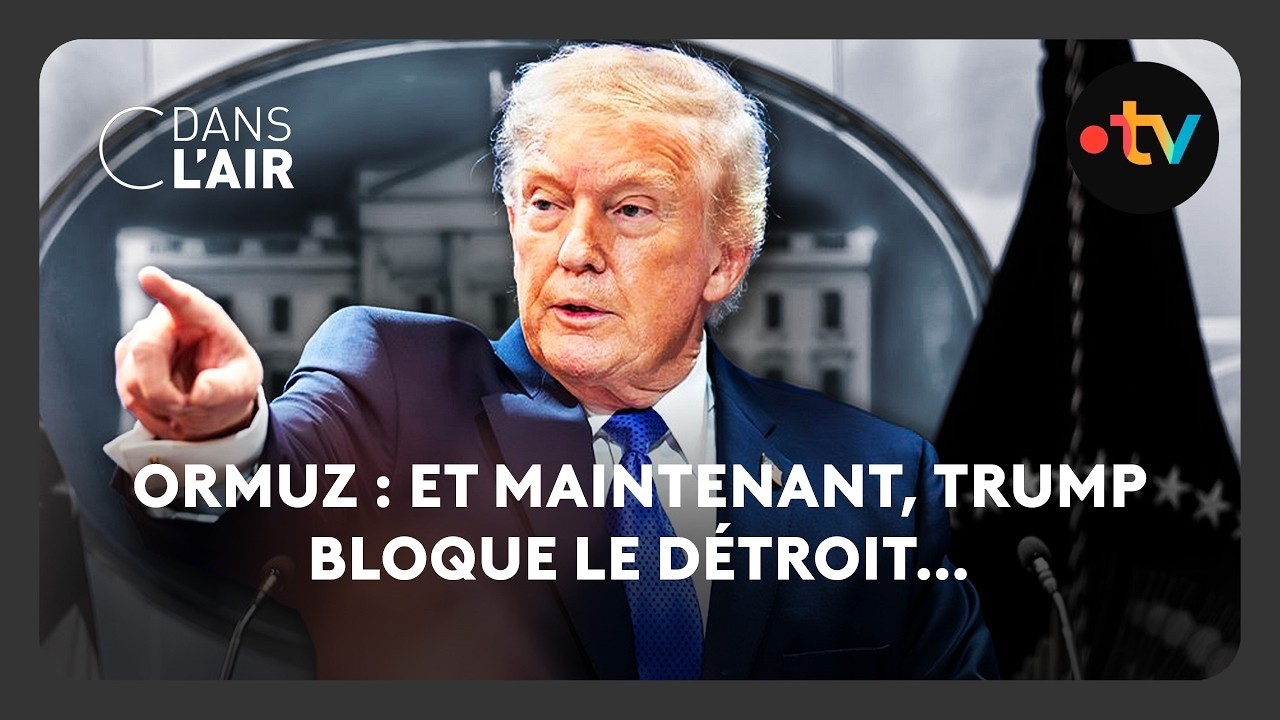
A French current-affairs panel examines Trump’s declared blockade of the Strait of Hormuz, arguing it is a coercive pressure tactic that risks higher oil prices, shipping disruption, and wider economic damage. The guests say the standoff is unlikely to be resolved quickly because neither the U.S. nor Iran wants to make the necessary concessions.
Watch on YouTube ›Get the market thesis, key claims, assets, contradictions, and follow-up questions from any financial video — then unlock a version personalized to your portfolio, watchlist, and favorite speakers.
This C dans l’air segment is a geopolitical and market discussion centered on the announced U.S. blockade of the Strait of Hormuz, the breakdown of U.S.-Iran negotiations, and the knock-on effects for oil, shipping, insurance, and global growth. The host, Christine Roux, opens by describing the Strait as officially closed and quoting Trump’s warning that ships approaching the blockade would be destroyed. The guests then unpack what the blockade actually means in practice: not a clean naval closure, but a selective interdiction effort involving U.S. warships, intelligence, inspection, and a search for leverage over Iranian exports. General Perruche argues the operation is less a classic naval blockade than a confrontation and an information war, where the U.S. first tries to restore confidence in passage and then filters traffic. …
Immediate risk is escalation: if the U.S. starts intercepting or boarding vessels and Iran retaliates, oil and shipping costs can spike again very quickly. The market is most vulnerable to a headline-driven break higher in crude, gasoline, and freight if a tanker or warship is hit.
Over the next few weeks, the base case in the panel is a grinding coercion phase with intermittent talks, limited concessions, and periodic tests of resolve. Confirmation would come from whether tanker flows, insurance pricing, and Chinese diplomacy stabilize; failure there would mean a more persistent energy shock.
Structurally, the episode argues that the world is entering a more fragile maritime regime where chokepoints like Hormuz and Bab al-Mandab can transmit regional conflict into global inflation. The durable implication is higher geopolitical risk premia for energy, shipping, and defense, with the U.S. also facing a growing cost-of-force problem.
Trump’s announced Hormuz blockade is a response to failed negotiations and is meant to prevent Iran from financing itself through oil sales.
The host says the blockade follows the failure of talks and several guests say the aim is to hit Iran’s wallet and stop oil revenue.
The blockade is not a clean closure but a selective interdiction or filtering regime that still allows some transit under heavy scrutiny.
Perruche and Pirot both explain that this is not a true absolute blockade and that ships may still pass depending on identification and control.
The immediate market consequence is higher oil prices, with the panel citing crude above $100 per barrel and a jump in gasoline costs.
The segment explicitly links the Hormuz standoff to the oil price move and to rising retail fuel prices.
Depuis 16h, c'est fermé par les Américains ? Blocus militaire du détroit d'Ormuz ? Blocus quoi ?
Le général Perruche explique qu'il s'agit d'une réponse au blocage iranien, mais que ce n'est pas un vrai blocus mais plutôt un barrage sélectif. Il détaille la planification nécessaire: donner confiance avec des navires de guerre, puis faire passer les pétroliers avec une phase de discrimination et de suivi.
Les Iraniens ont réagi au blocus américain. Ca veut dire quoi ?
M.Pirzadeh explique que les Iraniens menacent le Golfe. On est dans un cessez-le-feu très precaire. D.Trump a annoncé pouvoir bombarder l'Iran avec des frappes ciblées, et les Iraniens repercuteront cela sur le Golfe en frappant en simultane et similarite les pays du Golfe.
Pourquoi les Iraniens reagiraient-ils ? Qu'est-ce qu'ils pourraient faire ? Passer en force ?
Le general Perruche repond que si les Iraniens ne font rien, ils acceptent d'etre etrangles economiquement. Ils ont des reserves deployees dans certains pays du monde et peuvent echapper temporairement a un blocus pendant quelques mois, ce qui est beaucoup dans la vision de D.Trump.
Unlock the full claims, asset map, scores, related transcripts, follow-up questions, and AI chat — shaped around your portfolio, watchlist, favorite speakers, and risks.
