
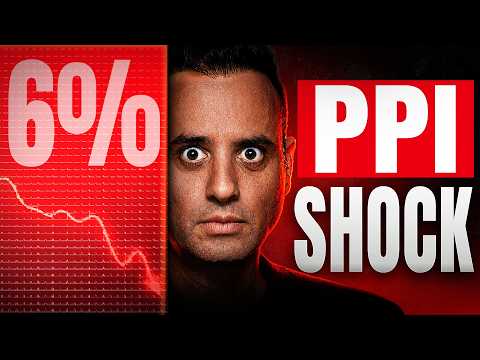
The speaker argues that hotter-than-expected producer inflation is a serious warning sign, but says markets are still ignoring bad news and remain euphoric. He frames Trump’s China trip as a high-stakes business/policy mission involving major CEOs, while also saying Bitcoin and crypto are likely to follow the S&P 500 and remain vulnerable if the broader market rolls over.
Watch on YouTube ›Get the market thesis, key claims, assets, contradictions, and follow-up questions from any financial video — then unlock a version personalized to your portfolio, watchlist, and favorite speakers.
The video is a market rant/wrap centered on three themes: the PPI print, Trump’s trip to China, and the condition of risk markets. The speaker says CPI at 3.8% was manageable, but PPI at 6% versus 4.9% expected is a large miss and matters more because producer inflation should filter into consumer prices over the next few months. From that he argues inflation could run hotter in the coming quarter, which would make rate cuts difficult or impossible, especially in the context of a newly installed Fed chair he repeatedly calls Kevin Walsh. He notes that the market’s current policy pricing is confused, with no rate cuts expected in 2026 and even a rate hike being priced further out. He then shifts to Trump’s China visit, describing it as a major business delegation with figures such as Jensen Huang, Elon Musk, Tim Cook, Larry Fink, David Solomon, and others. …
Near term, the setup is fragile: a hot PPI print and narrow leadership make the market vulnerable even though price action is still holding up. I’d treat the current tape as chase-risky until Bitcoin and equities confirm strength above the levels he cites.
Over the next few weeks, the market likely stays driven by a few megacap leaders unless inflation cools or Trump’s China trip produces a clearly positive policy surprise. If breadth worsens and inflation stays hot, the tape looks like a late-cycle extension rather than a durable breakout.
Structurally, the transcript argues we are in a concentration-heavy, inflation-sensitive regime where asset holders benefit and broad participation deteriorates. The lasting implication is higher systemic risk from narrow leadership and a market increasingly dependent on policy and AI megacaps.
The 6% PPI print is a much bigger problem than the 3.8% CPI print because producer inflation should feed into consumer prices over the next few months.
He explicitly says PPI is the worrying number and explains the lag into consumer prices.
High inflation means the Fed cannot meaningfully cut rates, contradicting the market’s hoped-for policy easing.
He ties the PPI surprise directly to rate-cut impossibility.
The market’s current rate expectations are confused, with no cuts expected in 2026 and even a hike priced farther out.
He says the probabilities page implies no cuts and a later hike.
Unlock the full claims, asset map, scores, related transcripts, follow-up questions, and AI chat — shaped around your portfolio, watchlist, favorite speakers, and risks.
