TranscriptAgent
Try it free
TRANSCRIPTAGENT.AI · transcript analysis

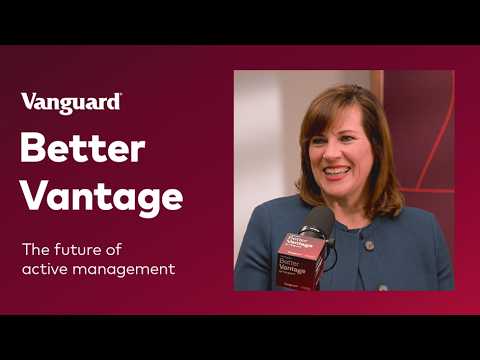
Better Vantage | The future of active management

Channel: Vanguard Published: 2026-05-13 12:00
Vanguard

Vanguard’s podcast argues that active management has struggled in the index-fund era because QE and extreme market concentration made outperformance harder, but Jean Hynes says AI and broader market change could create a new tailwind for skilled active managers. The discussion also frames private markets as a growing part of the opportunity set, with access and liquidity tradeoffs becoming a bigger issue for individual investors.

Watch on YouTube ›

Get the market thesis, key claims, assets, contradictions, and follow-up questions from any financial video — then unlock a version personalized to your portfolio, watchlist, and favorite speakers.

Detailed summary

This episode of Vanguard’s Better Vantage is a structured discussion on the active-versus-index debate, hosted by Christine Kashkari with Joe Davis as co-host and Jean Hynes, CEO of Wellington Management, as guest. The conversation starts with the long-running shift toward indexing: cash flows into index funds have exceeded $5.8 trillion while active equity funds have seen $2.5 trillion of outflows. Hynes argues that the post-2010 period was unusually difficult for active managers because global quantitative easing compressed dispersion across stocks, and the subsequent rise of a small group of huge, innovative U.S. …

🔒 The full detailed summary continues — read all of it free with an account. Read the full summary →

Main takeaways

  1. Indexing’s dominance has been reinforced by a tough backdrop for stock pickers: QE-era low dispersion and today’s narrow market leadership.
  2. Hynes thinks AI could widen the opportunity set for active managers if it meaningfully changes business models across industries.
  3. A five-year horizon is presented as the minimum useful window for judging active-manager skill.
  4. Private markets are framed as an expanding part of the investable economy, but access and liquidity are the core constraints for individuals.
  5. Public and private investing are described as a continuum, especially in sectors like biotech.
  6. The speaker’s process emphasis is on domain expertise, insight generation, decisive action, and portfolio construction.
  7. Her tone is pro-active management, but not in a blanket way; skill must be persistent and evidence-based.

Market read by horizon

Short term

Near term, the key tactical question is whether AI concentration continues to dominate benchmark performance or starts to widen out. That matters most for active managers, because a narrow leadership tape can keep stock pickers under pressure even if underlying skill is improving.

  • The immediate setup is a debate over whether current AI-led concentration in a few megacap names can persist or begin to broaden out.
Show more
  • If AI expectations weaken, the concentrated leaders could de-rate and active managers would likely have more room to outperform.
  • If AI adoption accelerates across the economy, near-term earnings revisions may migrate beyond the current small set of winners.
Mid term

Over the next several months, the base case is a gradual broadening of market participation if AI adoption starts showing up in more sectors and at more valuation tiers. If that breadth shift occurs, it should improve the environment for active managers relative to the last post-QE decade.

  • Over the next several quarters, the base case presented is broader change in market leadership as AI use cases spread beyond the current winners.
Show more
  • The validation signal would be earnings and revenue benefits showing up in a wider set of companies, including those trading at lower valuations.
  • If dispersion rises as QE effects fully fade, active managers should have a more favorable backdrop for stock selection.
Long term

Structurally, the episode argues that active management can regain relevance when market dispersion rises and when new technologies reshape business models across the economy. The longer-run implication is that investors may need a public/private continuum and a more flexible definition of active skill.

  • Structurally, the episode argues that market structure—not just manager talent—drives the success or failure of active management regimes.
Show more
  • AI is framed as a general-purpose technology with economy-wide implications, similar to electricity, implying a durable business-model reset rather than a one-sector story.
  • Private markets may become a larger permanent component of household portfolios as companies stay private longer and public markets represent a shrinking share of growth creation.
Unlock the full horizon read See the full short-term, mid-term, and long-term implications with confirmation and invalidation signals. Unlock horizon read

Key claims (10)

NEUTRAL active vs passive index funds / active equity funds

Index funds have absorbed vastly more capital than active equity funds over the last decade-plus.

The episode opens with a large flow imbalance favoring indexing and outflows from active equity funds.

BEARISH quantitative easing active management

The post-2010 era after the global financial crisis was unusually hard for active managers because QE reduced dispersion.

Hynes directly links broad quantitative easing to lower cross-sectional dispersion and weaker active performance.

BEARISH market concentration Mag Seven / U.S. indices / AI stocks

The concentration of market returns in a handful of large AI and technology names is historically unusual and has made benchmark beating harder.

She argues the market is concentrated in a very small number of stocks and a small sector, especially AI.

Unlock 7 more claims See the full bullish, bearish, and counter-consensus argument map extracted from the transcript. Unlock all claims

Assets discussed (8)

index funds
BULLISH etf

Presented as the major beneficiary of investor flows over the last decade-plus, with more than $5.8 trillion in cash flows.

active equity funds
BEARISH etf

Described as having suffered $2.5 trillion of outflows and as having struggled to beat benchmarks in the last 15 years.

Unlock the full asset map (6 more) See all assets mentioned, their directional bias, and the exact reasoning. Unlock asset map

Speakers

HOST Christine Kashkari HOST Joe Davis GUEST Jean Hynes

Interview (4 Q&A)

index fund growth

Can you talk a little bit about what the circumstances that brought about the rise of index funds?

Hynes says the real growth in indexing began after the global financial crisis, and she attributes active underperformance to QE-driven low dispersion plus recent concentration in a small number of giant AI/technology names.

active manager selection

How do you go about saying, 'I want to find the top third'? What are some of the criteria that I should be looking for?

Hynes says investors need a long horizon, at least five years, to judge skill and should look for firms that can persistently deliver across cycles.

AI and active management

How is AI upending all of this?

Hynes says AI has two paths: if it disappoints, market breadth improves through de-rating; if it works broadly, benefits spread across many industries. She leans toward the second outcome and thinks AI may help active managers by increasing change and dispersion.

Unlock the full interview (1 more Q&A) Every question, answer summary, and YouTube timestamp. Unlock full Q&A

Where this transcript pushes against consensus

  • The claim that AI will likely follow the more optimistic path is presented as a strong hunch, but the evidence is more narrative than analytical.
  • The notion that private markets will become broadly accessible to individuals in the next decade is asserted confidently, but no mechanism or regulatory path is laid out.
  • The comparison of AI to electricity is evocative but not fully defended; it may overstate the breadth and inevitability of the analogy.
  • The episode implies active management may enter a renaissance, but it does not specify what evidence would falsify that view beyond generic underperformance.
  • The repeated emphasis on long time horizons is reasonable, but it may underweight the reality that many investors cannot evaluate or tolerate multi-year lag periods.

Topics

active vs passiveindex fund growthmarket concentrationAI and investingprivate marketsliquidity tradeoffWellington Managementpharma and biotech researchmanager selectionportfolio construction

Create your free research agent

Unlock the full claims, asset map, scores, related transcripts, follow-up questions, and AI chat — shaped around your portfolio, watchlist, favorite speakers, and risks.

  • Full claims and asset map
  • Personalized relevance to your watchlist
  • Follow-up questions you can track
  • Related transcripts from your workspace
  • AI chat about this video
Create your free research agent
TRANSCRIPTAGENT.AI