TranscriptAgent
Try it free
TRANSCRIPTAGENT.AI · transcript analysis

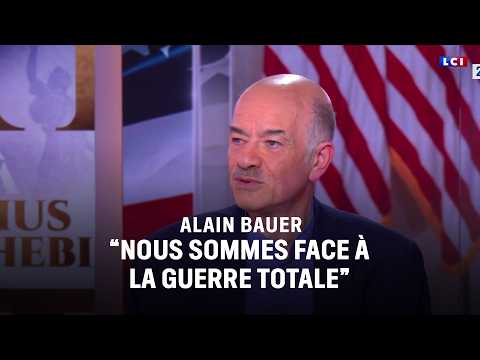
"Nous sommes face à la guerre totale", Alain Bauer|LCI

Channel: LCI Published: 2026-05-14 05:00
LCI

Alain Bauer argues that the world is entering a broader, already-active conflict centered on U.S.-China rivalry, Middle East choke points, and accelerating military-industrial competition. He says China has structural leverage through rare earths, industrial capacity, and trade routes, while the U.S. is showing force but remains constrained by aging hardware, depleted stocks, and slow rearmament.

Watch on YouTube ›

Get the market thesis, key claims, assets, contradictions, and follow-up questions from any financial video — then unlock a version personalized to your portfolio, watchlist, and favorite speakers.

Detailed summary

This LCI segment is built around a long exchange with Alain Bauer about Donald Trump’s appearance in China, the geopolitical symbolism of U.S. military deployments, and the wider logic of confrontation between the United States, China, Iran, and their regional partners. Bauer’s central argument is that the world is no longer dealing with isolated crises but with a single connected struggle over industrial power, trade routes, raw materials, naval access, and military deterrence. He opens by saying Trump’s trip to China is presented as a moment of imperial face-off, but he argues the real balance of power currently favors China in many domains: rare earths, industrial modernity, advanced manufacturing, and the ability to shape supply chains. At the same time, he says the U.S. …

🔒 The full detailed summary continues — read all of it free with an account. Read the full summary →

Main takeaways

  1. Bauer’s core view is that the U.S.-China rivalry is now a systemic struggle over industry, logistics, and military power, not just a trade dispute.
  2. China is portrayed as holding key structural advantages in rare earths, manufacturing, drones, and long-term industrial planning.
  3. The U.S. is still dangerous militarily, but its defense base, stockpiles, and procurement system are described as too slow and depleted for a prolonged contest.
  4. The Middle East, especially Iran and the Gulf states, is presented as one theater inside a larger global confrontation.
  5. He sees drone warfare and anti-drone defenses as a major proof point that Western militaries are behind and scrambling to adapt.
  6. He rejects a simple civilizational clash and instead frames the period as a return of empires, humiliation, and historical revenge.
  7. France, in his view, has a narrow path through sovereignty, Indo-Pacific partnerships, and strategic realism rather than moral posturing.

Market read by horizon

Short term

Near term, the setup is tactical escalation risk around Iran, Gulf infrastructure, and shipping lanes, with U.S. force posture used as deterrence signaling. Any fresh strike reports or proof of Gulf-state involvement could quickly reprice energy, defense, and transport risk.

  • Immediate focus is the visible escalation around Iran, the Gulf, and U.S. force posture, especially submarine, bomber, and carrier-style signaling.
Show more
  • The market-sensitive risk is that the current ceasefire or pause breaks and triggers another wave of strikes, shipping disruption, or retaliatory drone/missile activity.
  • Watch for pressure on oil logistics, shipping insurance, Gulf infrastructure, and anything tied to the Strait of Hormuz or Red Sea routes.
Mid term

Over the next several weeks or months, the likely path is stop-start confrontation plus bargaining, with the key question being whether pressure on Iran and the region can be sustained without widening the conflict. The cleaner confirmation would be restored route security and proof that underground Iranian capabilities are actually degraded.

  • Over weeks and months, the base case in the interview is continued fragmented conflict rather than a clean end-state, with periodic escalation and bargaining.
Show more
  • Validation would come from whether the U.S. can sustain pressure and whether Iran’s underground infrastructure is genuinely degraded or quickly reconstituted.
  • China’s preferred path, in Bauer’s telling, is stability and trade continuity, so any reopening of routes would support de-escalation.
Long term

Structurally, the interview argues for a durable shift toward empire competition driven by industrial capacity, logistics control, and military rearmament. If that regime holds, China’s manufacturing depth and the West’s defense-industrial lag become the defining long-run market and security variables.

  • The structural thesis is that the West is losing its manufacturing and military-industrial edge while China is building a broader, more integrated power system.
Show more
  • He implies a lasting regime shift toward multipolar empire competition, with logistics, energy, rare earths, and autonomous weapons at the center.
  • Western societies may face persistent vulnerability from demographic decline, defense deindustrialization, and strategic dependence on U.S. technology and hardware.
Unlock the full horizon read See the full short-term, mid-term, and long-term implications with confirmation and invalidation signals. Unlock horizon read

Key claims (9)

NEUTRAL U.S.-China rivalry Donald Trump / China

The meeting image is not a diplomatic slight but a very high-level Chinese reception with heavy symbolism.

Bauer says the vice president is hosting and that it is an exceptional, theatrical welcome rather than an insult.

BULLISH China industrial power China

China currently holds the leverage in the broader confrontation because it has rare earths, industrial modernity, and supply-chain depth.

He directly says China has the keys to rare earths and much of modern industrial production.

BEARISH U.S. military readiness United States military

The U.S. defense-industrial base is slower and more depleted than it appears on paper.

He cites old submarines, weak operational readiness, low stocks, and slow replacement timelines.

Unlock 6 more claims See the full bullish, bearish, and counter-consensus argument map extracted from the transcript. Unlock all claims

Assets discussed (17)

Donald Trump
UNCLEAR other

Used as the central political figure in the U.S.-China and Iran signaling discussion, not as a tradable asset.

China
BULLISH other

Presented as the dominant long-term industrial and strategic power with leverage in rare earths, manufacturing, and logistics.

Unlock the full asset map (15 more) See all assets mentioned, their directional bias, and the exact reasoning. Unlock asset map

Speakers

HOST Interviewer GUEST Alain Bauer

Interview (9 Q&A)

accueil en Chine

Quel est votre premier commentaire sur cette image d'accueil de Donald Trump en Chine ?

Alain Bauer explique que l'accueil est exceptionnel par son niveau, assuré par le vice-président chinois et non par le ministre des affaires étrangères. Il insiste sur la forte mise en scène diplomatique et sur le fait que la Chine règle aussi des irritants liés à certaines personnes de la suite de Trump, notamment Marco Rubio.

rapport de force

Qui est en position de force dans cet affrontement à Pékin ?

Il répond que, pour l'instant, c'est la Chine. Selon lui, Pékin détient des leviers essentiels, notamment sur l'Iran, les terres rares et une grande partie de la modernité industrielle, même si la Chine reste aussi dépendante de certaines opérations américaines.

puissance chinoise

Pouvez-vous expliquer comment la Chine est devenue une puissance industrielle et technologique ?

Il rattache cette montée en puissance à Deng Xiaoping, décrit comme l'homme de la renaissance chinoise après le maoïsme. Il explique que la Chine est passée d'une production bon marché à une capacité d'innovation, de recherche-développement et de hautes technologies, et qu'elle prépare déjà l'étape suivante, comme l'hydrogène.

Unlock the full interview (6 more Q&A) Every question, answer summary, and YouTube timestamp. Unlock full Q&A

Where this transcript pushes against consensus

  • Several factual claims are presented as near-certainties without clear sourcing in the transcript, especially around covert Gulf participation and the scale of remaining Iranian assets.
  • The assertion that China will be ahead in all high-tech domains within 10 years is highly speculative and stated with more confidence than evidence shown.
  • Claims that the U.S. has essentially lost major military capabilities are overstated; the transcript mixes real procurement bottlenecks with broad, unsupported extrapolation.
  • The speaker frequently generalizes from symbolic military images to sweeping conclusions about strategic balance.
  • Some historical analogies and civilizational framing blur evidence-based analysis and ideology, especially when moving from current events to broad claims about “revanche” and national decline.

Topics

U.S.-China rivalryChina industrial powerrare earthsdrones and anti-dronesIran conflictGulf statesmaritime chokepointsmilitary stockpilesFrench sovereigntymultipolar empire politics

Create your free research agent

Unlock the full claims, asset map, scores, related transcripts, follow-up questions, and AI chat — shaped around your portfolio, watchlist, favorite speakers, and risks.

  • Full claims and asset map
  • Personalized relevance to your watchlist
  • Follow-up questions you can track
  • Related transcripts from your workspace
  • AI chat about this video
Create your free research agent
TRANSCRIPTAGENT.AI