TranscriptAgent
Try it free
TRANSCRIPTAGENT.AI · transcript analysis

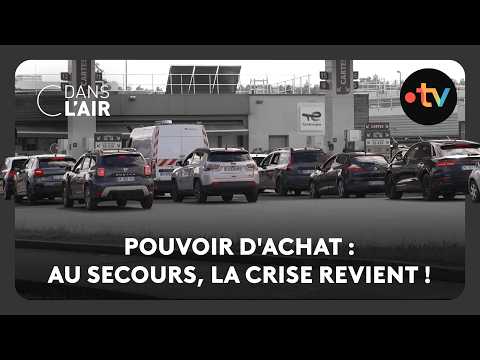
Pouvoir d'achat : au secours, la crise revient !

Channel: C dans l'air - France Télévisions Published: 2026-05-15 13:00
C dans l'air - France Télévisions

France Télévisions’ C dans l’air frames a rising cost-of-living and energy squeeze in France as an emerging economic crisis, driven by higher fuel prices, weak growth, rising unemployment, and political paralysis that limits government response.

Watch on YouTube ›

Get the market thesis, key claims, assets, contradictions, and follow-up questions from any financial video — then unlock a version personalized to your portfolio, watchlist, and favorite speakers.

Detailed summary

This episode is a panel discussion about whether France is entering a real economic crisis. The host opens with a stark setup: inflation is re-accelerating, fuel prices remain elevated, unemployment is back above 8%, debt is rising, and the Ormuz Strait disruption is feeding into everyday French life. The guests largely agree that the country is at least at the start of a crisis or approaching one. Gaëlle Macke argues that the French economy has been resilient through multiple shocks since Covid, but that this resilience is now exhausted and growth is heading toward zero at best. Philippe Geoffron separates the issue into demand effects and precautionary behavior: when pump prices exceed 2 euros, people reduce travel, and the state has less room for broad support because repeated crises have already used up the old ‘quoi qu’il en coûte’ reflex. …

🔒 The full detailed summary continues — read all of it free with an account. Read the full summary →

Main takeaways

  1. The panel treats France’s cost-of-living shock as more than a temporary squeeze: it is being framed as the beginning of an economic downturn.
  2. Fuel prices and the Ormuz Strait disruption are the immediate trigger, but the larger issue is the exhaustion of fiscal and political room to respond.
  3. Government help is described as targeted and limited, not a return to broad crisis spending.
  4. Taxing oil superprofits is discussed as politically attractive but economically messy and possibly ineffective.
  5. Households are already changing behavior quickly: fewer trips, lower fuel use, downtrading on food, leisure, and clothing.
  6. The episode links current stress to deeper structural issues: industrial fragility, inequality, labor-market mismatch for seniors, and AI-driven job disruption.

Market read by horizon

Short term

Tactically, the setup is bearish for French domestic consumption and politically sensitive for energy names while pump prices remain elevated and Ormuz uncertainty persists. The main near-term risk is another leg of household pullback and headline-driven pressure on TotalEnergies.

  • The immediate market/policy focus is fuel: prices at the pump, consumption drops, and whether the Ormuz Strait disruption persists.
Show more
  • A near-term risk is further pressure on French household spending and retail demand as consumers cut travel and discretionary purchases.
  • The government is leaning toward targeted measures rather than a broad price freeze, which may disappoint households and keep social tension elevated.
Mid term

Over the next few months, the panel’s base case is slower French growth with sticky inflation and weak policy room, unless energy prices normalize and mobility rebounds. A sustained move back below 2 euros at the pump and a geopolitical de-escalation would be needed to reduce the drag.

  • Over the next several weeks to months, the base case in the discussion is slower French growth, potentially near zero, with inflation still sticky or worsening from energy diffusion.
Show more
  • If the geopolitical shock eases by mid-year, some normalization in fuel prices and mobility could follow, but the panel does not expect a quick return to prior growth assumptions.
  • The key confirmation signal would be whether consumer retrenchment spreads from fuel into broader consumption, hiring, and company failures.
Long term

Structurally, France is described as living in a lower-resilience regime where imported energy, fiscal limits, and labor-market mismatch matter more than temporary stimulus. The long-run implication is that decarbonization, local production, and redistribution debates will increasingly define economic stability.

  • Structurally, the episode argues France is in a more fragile regime: lower tolerance for external shocks, tighter public finances, and weaker ability to smooth crises with fiscal policy.
Show more
  • The durable thesis is that imported-energy dependence and deindustrialization leave the economy exposed, making decarbonization, local production, and infrastructure investment more important than temporary subsidies.
  • A second structural theme is labor-market mismatch: older workers, lower-paid essential workers, and white-collar employees facing AI disruption all point to a need for rethinking work and redistribution.
Unlock the full horizon read See the full short-term, mid-term, and long-term implications with confirmation and invalidation signals. Unlock horizon read

Key claims (7)

BEARISH French economic slowdown France

France is entering the beginning of an economic crisis rather than merely a temporary slowdown.

The panel says resilience is exhausted, growth is effectively zero, inflation worsens, and unemployment rises above 8%.

BEARISH energy shock fuel

Rising fuel prices are already reducing mobility and fuel consumption sharply in France.

The panel cites a 30% decline in early-May fuel consumption and notes behavior changes like fewer trips and more carpooling.

BEARISH fiscal constraints France

The French government lacks budgetary room for a broad return to crisis-style support.

Michel-Aguirre says the budget margin is zero and broad tax-freeze measures are not possible now.

Unlock 4 more claims See the full bullish, bearish, and counter-consensus argument map extracted from the transcript. Unlock all claims

Assets discussed (7)

TotalEnergies
MIXED stock

Presented as a profit beneficiary of higher energy prices and a potential target for taxes or margin caps; also discussed for its price-plafond actions.

shein
BULLISH other

Mentioned as a low-cost shopping platform gaining demand as consumers downtrade.

Unlock the full asset map (5 more) See all assets mentioned, their directional bias, and the exact reasoning. Unlock asset map

Speakers

HOST A. Casse GUEST P. Geoffron GUEST C. Michel-Aguirre GUEST G. Macke GUEST G.Sliman

Interview (2 Q&A)

priorités énergétiques

Quel est l'essentiel, selon vous, dans le débat sur Total et la taxation?

P.Geoffron répond que l'essentiel est de demander à Total de financer des solutions structurelles comme un plan de leasing social pour véhicules électriques ou le renforcement du réseau de recharge, au lieu de bloquer les prix ce qui crée des distorsions. Tout le reste n'est que du paracétamol.

pénurie kérosène

Est-ce que la pénurie de kérosène pourrait être un problème?

P.Geoffron répond que cela pourrait déboucher sur un problème pour la France, première destination touristique mondiale, car les visiteurs viennent d'Asie et des Etats-Unis. Le pouvoir d'achat américain pèse aussi, et c'est un vrai sujet pour la croissance française au regard du poids du tourisme.

Where this transcript pushes against consensus

  • Geoffron and Michel-Aguirre are skeptical that taxing Total superprofits or capping prices is an effective fix; they see it as distortionary and mostly symbolic.
  • Macke is somewhat more open to political pressure on Total, while Geoffron argues that the real issue is decarbonization and supply resilience, not redistribution through energy taxes.
  • Sliman suggests the risk of a gilets jaunes-style revolt is limited before the election, while Michel-Aguirre thinks post-election social conflict could be more explosive.
  • There is some tension between the panel’s mid-year normalization scenario for oil and the more pessimistic view that the Ormuz situation may remain blocked for months.
  • The AI segment includes optimism about productivity and wealth creation, but the guests sharply disagree on whether that will translate into jobs without new redistribution mechanisms.

Topics

French inflation and purchasing powerfuel prices and energy shockOrmuz Strait and geopoliticsgovernment aid and fiscal limitsTotalEnergies and superprofits taxconsumer downtrading and retail pressurecompany failures and corporate distresssenior unemployment and labor-market mismatchAI and job displacementmade in France and industrial resilience

Create your free research agent

Unlock the full claims, asset map, scores, related transcripts, follow-up questions, and AI chat — shaped around your portfolio, watchlist, favorite speakers, and risks.

  • Full claims and asset map
  • Personalized relevance to your watchlist
  • Follow-up questions you can track
  • Related transcripts from your workspace
  • AI chat about this video
Create your free research agent
TRANSCRIPTAGENT.AI