TranscriptAgent
Try it free
TRANSCRIPTAGENT.AI · transcript analysis

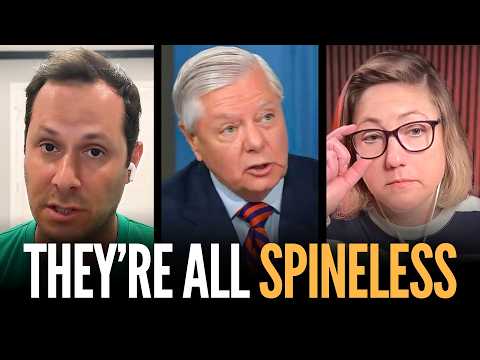
Lindsey Graham Finally Says What Republicans Really Believe

Channel: The Bulwark Published: 2026-05-17 16:08
The Bulwark

Sam Stein and Sarah Longwell argue that Bill Cassidy’s Louisiana primary loss was driven by Republican voters viewing him as a Trump traitor, and that trying to halfway oppose Trump while later seeking his approval is politically fatal. They use Cassidy, Mitt Romney, Susan Collins, Tom Massie, and Lindsey Graham to illustrate how the GOP now rewards total loyalty and punishes partial resistance.

Watch on YouTube ›

Get the market thesis, key claims, assets, contradictions, and follow-up questions from any financial video — then unlock a version personalized to your portfolio, watchlist, and favorite speakers.

Detailed summary

This segment is a political commentary on Senator Bill Cassidy’s primary loss in Louisiana. Sam Stein opens by framing the result as a convincing defeat for Cassidy, emphasizing that the central reason was Cassidy’s vote to convict Trump after January 6. Sarah Longwell says her prior focus-group work already suggested Cassidy was in trouble because Republican voters saw him as disloyal to Trump, with additional complaints about COVID, masking, and vaccines. The discussion then broadens into a critique of the Republican Party’s incentives. Longwell and Stein argue that Trump still controls enough of the GOP primary base to determine outcomes, and that politicians who cross him cannot realistically return to favor. They contrast Cassidy with figures who either fully complied with Trump or, in their view, acted with clearer conviction. …

🔒 The full detailed summary continues — read all of it free with an account. Read the full summary →

Main takeaways

  1. Cassidy’s loss is presented as a punishment for crossing Trump, especially over January 6.
  2. The speakers argue that half-resistance to Trump is worse than either full compliance or clear conviction.
  3. Trump still dominates enough of the Republican primary electorate to shape outcomes.
  4. Lindsey Graham is used as an example of how completely some Republicans have subordinated themselves to Trump.
  5. Cassidy’s support for RFK Jr. is portrayed as a failed attempt to regain MAGA favor after doing the right thing on Trump.
  6. The speakers believe the post-Trump Republican reset is largely impossible because the party base now distrusts or hates the old guard.

Market read by horizon

Short term

Tactically, the near-term read is that Republicans will take Cassidy’s loss as proof that opposing Trump in a primary is still dangerous, especially if the challenge is framed as disloyalty. That raises the immediate risk of more incumbents overcorrecting toward Trump-aligned positions.

  • Cassidy’s defeat is the immediate signal: other Republicans will read it as a warning against opposing Trump in primaries.
Show more
  • Lindsey Graham’s public reaction reinforces the current incentive structure inside the GOP.
  • Tom Massie and Lauren Boebert are cited as near-term examples of how Trump treats even small defections.
Mid term

Over the next few months, the likely path is further tightening of Republican loyalty politics, with anti-Trump figures forced to choose between full-throated resistance and retreat. The setup would change only if a clearly independent Republican wins or survives after openly defying Trump.

  • Over the next several weeks and months, the speakers expect Republicans to learn that primary survival depends on avoiding direct conflict with Trump.
Show more
  • They think politicians who want to oppose Trump will have to choose between full confrontation and total submission; middle-ground positioning is unlikely to work.
  • Cassidy is treated as a cautionary example of what happens when moral opposition is followed by tactical retreat.
Long term

Structurally, the segment argues the GOP has entered a regime where Trump loyalty is the organizing principle of advancement and survival. If that persists, the long-run implication is a party culture that suppresses institutional dissent and makes post-Trump restoration much harder.

  • The segment argues that the Republican Party has become structurally defined by Trump loyalty, not traditional conservative principle.
Show more
  • In their view, the durable lesson is that elites who waited to resist Trump after he had already captured the party forfeited the chance to shape its future.
  • The long-run implication is a party that rewards performative submission and punishes institutional independence, making a clean post-Trump restoration difficult.
Unlock the full horizon read See the full short-term, mid-term, and long-term implications with confirmation and invalidation signals. Unlock horizon read

Key claims (8)

BEARISH Republican loyalty politics Bill Cassidy

Bill Cassidy lost his Louisiana primary mainly because he voted to convict Trump after January 6.

The host explicitly says the main reason for the loss was Cassidy's conviction vote after impeachment.

BEARISH Trump influence over GOP voters Bill Cassidy

Republican primary voters saw Cassidy as a traitor to Trump more than they cared about his policy positions.

Longwell says focus group voters were 'anyone but Cassidy' and framed him as a traitor to the party.

BULLISH GOP power structure Donald Trump

Trump still controls a large enough chunk of the GOP primary base to decide most Republican primaries.

Both speakers explicitly say Trump controls enough of the base to get his way in primaries.

Unlock 5 more claims See the full bullish, bearish, and counter-consensus argument map extracted from the transcript. Unlock all claims

Assets discussed (9)

Bill Cassidy
BEARISH other

Discussed as the incumbent senator who lost his primary after voting to convict Trump and later backing RFK Jr.; the segment is explicitly about his political collapse.

Donald Trump
BULLISH other

In the political sense of power within the GOP, the segment says Trump still dominates the Republican primary base and punishes defectors.

Unlock the full asset map (7 more) See all assets mentioned, their directional bias, and the exact reasoning. Unlock asset map

Speakers

HOST Sam Stein GUEST Sarah Longwell

Interview (3 Q&A)

Cassidy primary loss

What's your main takeaway from Bill Cassidy's loss in the Louisiana primary?

Sarah notes that focus group voters saw Cassidy as a traitor to Trump and the party, also citing complaints about his COVID/masking stances. Her main takeaway is that while crossing Trump is indeed deadly in a primary, if you're going to do it you must go all-in like Liz Cheney — not vote to convict and then try to curry favor by confirming RFK Jr., which costs you both your seat and your integrity.

crossing Trump consequences

Can you think of one Republican lawmaker who stood up to Trump and then got back in his good graces enough to survive a primary?

Sarah says only in 2016 people like Marco Rubio, Lindsey Graham, and Ted Cruz hugged Trump hardest to rehabilitate their images, but subsequent efforts against him have all failed. Sam adds that not a single person who cast an impeachment or conviction vote has found their way back into his good graces, though Susan Collins may be a partial exception since Trump is careful about her seat.

party reform challenge

Sarah, how do you do that? How do you make the true party shine through when the lesson lawmakers learn is never cross Trump?

Sarah argues that people like Mitt Romney who know how terrible Trump is but only sometimes stand up while otherwise trying to be a normal Republican are a net negative. Cassidy could have spent six years absolutely throwing fists — standing in the way of RFK, Patel, and being a voice for sanity — but instead sold out for nothing.

Where this transcript pushes against consensus

  • The speakers assume Cassidy had no plausible path to surviving after the conviction vote, but they do not consider whether a stronger local campaign or different issue emphasis might have changed the result.
  • They argue Trump will remain the decisive primary force, but provide limited concrete data in the segment beyond anecdotes and recent examples.
  • They treat Cassidy’s RFK Jr. vote as purely cynical or surrender-based, but do not seriously explore whether he believed the oversight deal could constrain RFK Jr. in practice.
  • The claim that no Republican who crossed Trump ever recovered is presented broadly; Susan Collins is briefly acknowledged as a possible exception, which weakens the absolutism.

Topics

Bill Cassidy primary lossTrump loyalty in GOPJanuary 6 conviction voteRFK Jr. confirmationLindsey GrahamSusan CollinsTom MassieLamar AlexanderRepublican primariesGOP post-Trump future

Create your free research agent

Unlock the full claims, asset map, scores, related transcripts, follow-up questions, and AI chat — shaped around your portfolio, watchlist, favorite speakers, and risks.

  • Full claims and asset map
  • Personalized relevance to your watchlist
  • Follow-up questions you can track
  • Related transcripts from your workspace
  • AI chat about this video
Create your free research agent
TRANSCRIPTAGENT.AI