
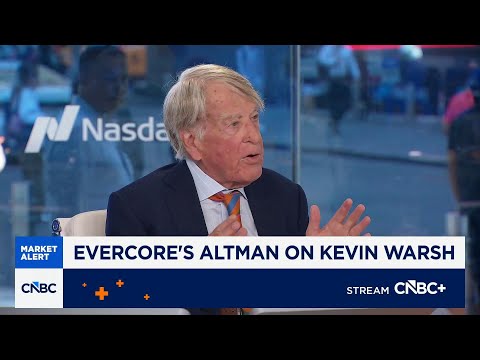
Roger Altman argues markets may be nearing a tipping point where a sharp oil spike could overpower currently resilient equities and the U.S. economy. He thinks the immediate risk is markets reacting before the real economic damage shows up, while the Fed’s path under Kevin Warsh could be constrained by higher inflation and yields.
Watch on YouTube ›Get the market thesis, key claims, assets, contradictions, and follow-up questions from any financial video — then unlock a version personalized to your portfolio, watchlist, and favorite speakers.
In this CNBC interview, Evercore founder and senior chairman Roger Altman says the key question is whether the oil market has reached a tipping point after recent geopolitical disruptions. He argues that 12 to 14 million barrels a day have effectively been taken out of the oil market versus roughly 102 million barrels of daily global consumption, and that the market’s buffers — high inventories, tankers at sea, strategic reserves, and China stockpiles — have largely been drawn down. In his view, that could cause the spread between physical crude prices and screen prices to widen, followed by a substantial jump in paper prices over the next two weeks. Altman is skeptical that markets can stay stable if oil moves toward $150 or worse, even though he says the underlying momentum in stocks and the economy has been strong. He points to corporate profits, a strong U.S. …
Near term, the actionable risk is that oil reprices violently before equity investors have time to discount the inflation hit. A break higher in crude alongside rising yields would be the immediate warning that the market is entering a more fragile phase.
Over the next few weeks to months, the base case is either a temporary energy spike that markets absorb or a sustained move that starts to pressure multiples and Fed expectations. The view is validated if oil stays bid, inflation data firm, and risk assets fail to shrug it off.
Structurally, the interview argues that the post-COVID inflation regime is not necessarily over and that energy shocks remain a durable macro risk. If geopolitics keeps constraining supply, markets may have to price a world where inflation can re-accelerate even with otherwise solid U.S. growth.
The oil market may be at a tipping point and could see substantially higher prices within the next two weeks.
Altman says the big question is whether we are at a tipping point in the oil market and about to see much higher prices.
The market’s cushion from high inventories, tankers at sea, strategic reserves, and China inventories has largely been drawn down.
He argues the factors that had cushioned oil prices are now no longer providing the same buffer.
Physical crude prices are likely to widen relative to screen prices, and the screen price could rise a lot.
He says the spread between actual physical delivery prices and screen prices is about to widen, then paper prices will move up significantly.
Why is the stock market shrugging off so many headwinds like $106 oil, rising rates, and uncertainty in Iran?
Altman says markets have been resilient because the underlying economy and corporate profits are strong, but he warns that an oil tipping point could overwhelm that resilience.
Would markets go first, or would you need to see demand destruction in the economy first?
He thinks markets would react first; broader economic damage could emerge later if the oil shock persists.
Do you like Kevin Warsh, and do you think he is the right choice?
Altman says Warsh is serious, thinks Trump made a good choice, and believes Warsh will likely act pragmatically once in office.
Unlock the full claims, asset map, scores, related transcripts, follow-up questions, and AI chat — shaped around your portfolio, watchlist, favorite speakers, and risks.
