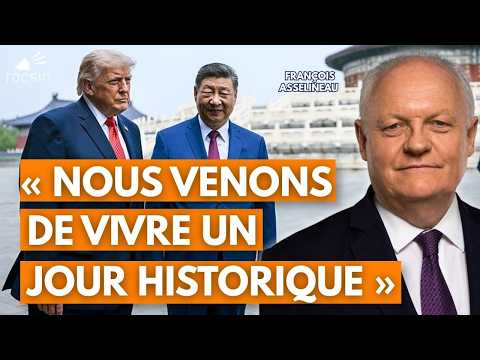
François Asselineau argues that the Trump–Xi meeting exposed a major shift in global power, with China now able to pressure the United States on Taiwan, chips, and broader strategic issues. He frames the encounter as a lesson in Chinese statecraft, historical depth, and Sun Tzu-style patience, while using it to criticize Western ignorance, NATO/EU irrelevance, and France’s strategic decline.
Watch on YouTube ›Get the market thesis, key claims, assets, contradictions, and follow-up questions from any financial video — then unlock a version personalized to your portfolio, watchlist, and favorite speakers.
This segment of Tocsin is an extended interview between the host and François Asselineau, identified as president of the UPR. The conversation begins with light political context, then quickly centers on the Trump–Xi meeting in Beijing. Asselineau’s core thesis is that the meeting symbolized a historic shift in power: in his view, China has become the first world power, and the United States arrived from a position of weakness despite Trump’s rhetoric. A large part of the discussion is devoted to Taiwan. Asselineau insists that Taiwan is historically part of China and that Beijing will never allow it to become independent. He argues that Xi’s reference to the “Thucydides Trap” was a deliberate strategic signal showing that Chinese leaders understand Western strategic thought, while Western leaders do not understand China’s historical self-conception. …
Tactically, the immediate read is that Beijing has the upper hand in the Trump-Xi narrative, so any near-term China-related headlines are more likely to pressure U.S. hawks than to force Chinese concessions. The main risk is renewed escalation on Taiwan or chips if Washington overreads its room to maneuver.
Over the next few months, the likely path in this framing is continued Chinese strategic patience: gradual normalization of its industrial base, selective trade concessions, and resistance to U.S. pressure without open confrontation. Confirmation would come from Beijing maintaining leverage on chips, Taiwan, and supply chains while Washington fails to assemble a stronger coalition.
The structural thesis is that the center of gravity is shifting toward a Beijing-centered order, with China increasingly setting the terms for diplomacy, industrial policy, and great-power bargaining. In that regime, Western influence depends less on moral claims and more on whether individual states retain sovereign strategic capacity.
Xi’s reference to the Thucydides Trap signaled that China understands the U.S. fears being overtaken and is willing to say so openly.
Asselineau interprets Xi’s language as a strategic message about power transition and U.S. decline.
The Trump-Xi meeting showed that the United States arrived in a position of weakness and left with little to show for it.
He says Trump got almost nothing beyond small trade gestures and looked subdued.
Taiwan is historically and politically inseparable from China, and Beijing will never allow it to become independent.
This is his strongest territorial thesis, backed by a long historical narrative.
Quelle est votre analyse de la rencontre Trump-Xi Jinping et de l'utilisation du terme 'piège de Thucydide' par Xi Jinping ?
François Asselineau insiste d'abord sur la prononciation correcte de Xi Jinping, puis explique que les Occidentaux et Américains combattent un pays et un système qu'ils ne connaissent pas. Il détaille l'histoire de Taïwan depuis la dynastie Ming pour montrer que les Chinois ne laisseront jamais Taïwan devenir indépendant. Il analyse ensuite la référence au 'piège de Thucydide' comme un signal que Xi Jinping sait que les Américains craignent d'être dépassés et les prévient que si les États-Unis continuent sur Taïwan, cela mènera à la guerre. Il note que Trump a compris qu'il n'avait pas les cartes en main sur ce dossier.
Êtes-vous d'accord que l'image de Trump revenant de Chine la tête rentrée dans les épaules est révélatrice, ou est-ce une surinterprétation ?
L'intervenant répond que Trump n'a rien obtenu de substantiel : il a vendu 200 Boeing mais en attendait 500, et les Chinois achètent selon leur propre calendrier. Ils n'avaient pas acheté de Boeing depuis 17 ans, c'était le moment pour eux d'en racheter, et ils développent leur propre concurrent (C919). Les gestes chinois servent leurs intérêts, pas ceux de Trump.
Est-ce que Donald Trump pensait vraiment qu'il obtiendrait le soutien de Xi Jinping en arrivant en situation de faiblesse ?
Unlock the full claims, asset map, scores, related transcripts, follow-up questions, and AI chat — shaped around your portfolio, watchlist, favorite speakers, and risks.