TranscriptAgent
Try it free
TRANSCRIPTAGENT.AI · transcript analysis

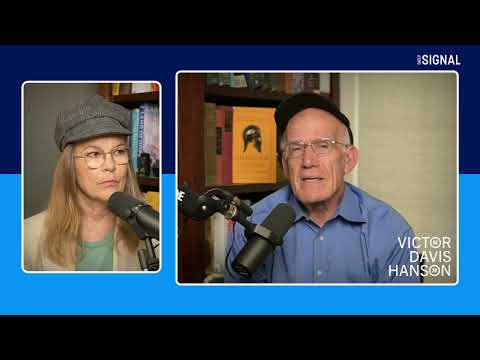
Victor Davis Hanson: The COVID Narrative Officially Collapsed

Channel: Victor Davis Hanson Published: 2026-05-19 06:00
Victor Davis Hanson

Victor Davis Hanson argues that Trump’s China trip was tactically successful, that China is an ascendant but ultimately constrained rival, and that the Iran confrontation is moving toward a decisive phase. He also says the COVID lab-leak narrative and suppression of dissent by health and intelligence bureaucracies now look increasingly confirmed, while citing California and Britain as examples of elites ignoring public anger over crime, censorship, and governance.

Watch on YouTube ›

Get the market thesis, key claims, assets, contradictions, and follow-up questions from any financial video — then unlock a version personalized to your portfolio, watchlist, and favorite speakers.

Detailed summary

This episode is a long-form conversational political and market-adjacent commentary between Jack Fowler and Victor Davis Hanson. It begins with Trump’s China trip, which Hanson calls good because Trump made no major concessions. Hanson frames Xi Jinping’s “Thucydides trap” language as provocative and historically overblown, arguing that the U.S. has faced multiple ‘ascendant powers’ before and prevailed. On China, he emphasizes structural weaknesses such as food dependence, lower fertility, and energy constraints, while saying the most immediate issues are whether China will materially aid Iran and whether it will help with the Strait of Hormuz. The discussion then shifts to Iran and the ongoing confrontation. Hanson says the conflict has already moved through a long period of haggling and that the U.S. and Israel are likely nearing a point where they will strike hard and quickly. …

🔒 The full detailed summary continues — read all of it free with an account. Read the full summary →

Main takeaways

  1. Trump’s China trip is presented as tactically successful because it avoided concessions and preserved ambiguity on Taiwan.
  2. Hanson thinks China remains powerful but is structurally weaker than it appears, especially on food, fertility, and energy.
  3. Iran is the main near-term geopolitical escalation risk; Hanson expects a hard, possibly overwhelming response if negotiations fail.
  4. A broader public backlash against elites, crime, censorship, and DEI is building in the U.S. and Britain.
  5. The COVID lab-leak story is framed as a bureaucratic cover-up that now looks increasingly validated.
  6. Bill Kristol’s party switch is treated as an ideological and personal betrayal rather than a principled evolution.

Market read by horizon

Short term

Immediate setup is geopolitics-first: Iran is the key catalyst, and any hint of strikes, tanker disruption, or Chinese support would hit sentiment quickly. The near-term risk is an energy shock and headline-driven volatility, not a clean China trade narrative.

  • Watch Iran: Hanson thinks the immediate catalyst is whether the U.S./Israel choose a decisive strike soon.
Show more
  • Oil is the tactical market variable he stresses most; he warns of supply disruption risk if Iran or proxies retaliate.
  • China’s role matters mainly through possible arms support to Iran and pressure around the Strait of Hormuz.
Mid term

Over the next few months, the base case is continued escalation pressure on Iran and persistent uncertainty around oil flows, with China mainly relevant as a possible backer or enabler. If deterrence holds, the trade becomes less about direct war and more about a higher-risk geopolitical premium embedded in energy and defense.

  • Over the next several weeks to months, Hanson’s base case is that pressure on Iran keeps building and the confrontation resolves one way or another, likely with force rather than endless negotiation.
Show more
  • He suggests energy markets could tighten materially if tankers are disrupted or Iranian assets are targeted, though he is uncertain whether this would be enough to drive gasoline to $2/gal.
  • China’s medium-term importance is as a secondary enabler or spoiler: if it materially assists Iran, the rivalry shifts from abstract competition to direct strategic alignment.
Long term

The structural thesis is that U.S. power remains the anchor of the system, while China, Iran, and revisionist blocs face real internal constraints despite headline strength. Hanson’s broader regime view is a world moving back toward hard-power competition, reciprocity, and skepticism toward bureaucratic expertise.

  • Hanson’s structural thesis is that the U.S. remains the dominant power and that repeated claims of a new hegemon overtaking it tend to be overstated.
Show more
  • He sees China as a durable strategic competitor, but one with deep internal constraints that limit its long-run ability to overtake the U.S.
  • The long-run regime implication is a more openly confrontational world in which reciprocity, hard power, and deterrence replace liberal-institutional assumptions.
Unlock the full horizon read See the full short-term, mid-term, and long-term implications with confirmation and invalidation signals. Unlock horizon read

Key claims (9)

BULLISH U.S.-China rivalry Donald Trump

Trump’s China trip was good because he made no comprehensive deals or concessions.

Hanson explicitly says the trip was good and stresses no concessions were made.

MIXED U.S.-China rivalry China

Xi Jinping’s Thucydides trap framing is provocative, but Hanson argues China is not in a position to overtake the U.S. easily.

He contrasts China’s structural weaknesses with repeated historical examples of failed challengers.

UNCLEAR Iran escalation China

The most important immediate China issue is whether Beijing materially helps Iran, especially on air defense or access to the Strait of Hormuz.

He frames these as the two real issues he can fathom from the coverage.

Unlock 6 more claims See the full bullish, bearish, and counter-consensus argument map extracted from the transcript. Unlock all claims

Assets discussed (6)

Donald Trump
BULLISH other

Presented as tactically strong on China and likely to act decisively on Iran.

China
MIXED other

Seen as an ascendant power and tactical rival, but also structurally constrained and vulnerable.

Unlock the full asset map (4 more) See all assets mentioned, their directional bias, and the exact reasoning. Unlock asset map

Speakers

SPEAKER Victor Davis Hanson HOST Jack Fowler

Interview (10 Q&A)

nation building failure

Should I revert to democracy or at least not so much nation building?

Victor responded that what doesn't work is nation building in Afghanistan, and while it kind of worked in Iraq it came at a terrible price.

Trump China policy

What is your take on what Donald Trump should be doing at this point now that he's back from China?

Victor thought Trump's China trip was good because he didn't make comprehensive deals or concessions. He found Xi's Thucydides Trap reference provocative. He argued that China fits the pattern of ascendant powers (like USSR, Japan, EU) that challenged the US and ultimately failed. He distilled the real issues to two: whether China will sell Iran arms (especially missile defense) and whether they'll help open the Strait, and in exchange whether the US will let Chinese tankers leave with oil. He concluded Trump's approach was pragmatic.

Nicole Wallace

Did you ever know Nicole Wallace?

Victor said he knows who she is and may have seen her at a party or two, but doesn't really know her.

Unlock the full interview (7 more Q&A) Every question, answer summary, and YouTube timestamp. Unlock full Q&A

Where this transcript pushes against consensus

  • Hanson treats the lab-leak cover-up as effectively settled, but much of the evidence is still inferential and politically contested.
  • He speaks with high confidence about China’s inability to challenge the U.S. militarily, but the argument relies heavily on comparative strength rhetoric rather than concrete scenario analysis.
  • The forecast that a U.S./Israeli strike could quickly overwhelm Iran may underestimate retaliation capacity and regional escalation risk.
  • His claim that public anger mostly belongs to nonvoters or that honest elections would sharply favor his side is asserted rather than demonstrated.
  • The Bill Kristol critique assumes his ideological shift is purely opportunistic and not partly genuine disagreement over Trump’s methods.

Topics

China-U.S. rivalryThucydides trapIran conflictoil supply shock riskCOVID lab leakFauci and Collinspublic backlash against elitesBritain migration and speechCalifornia politicsBill Kristol party switch

Create your free research agent

Unlock the full claims, asset map, scores, related transcripts, follow-up questions, and AI chat — shaped around your portfolio, watchlist, favorite speakers, and risks.
  • Full claims and asset map
  • Personalized relevance to your watchlist
  • Follow-up questions you can track
  • Related transcripts from your workspace
  • AI chat about this video
Create your free research agent
TRANSCRIPTAGENT.AI