TranscriptAgent
Try it free
TRANSCRIPTAGENT.AI · transcript analysis

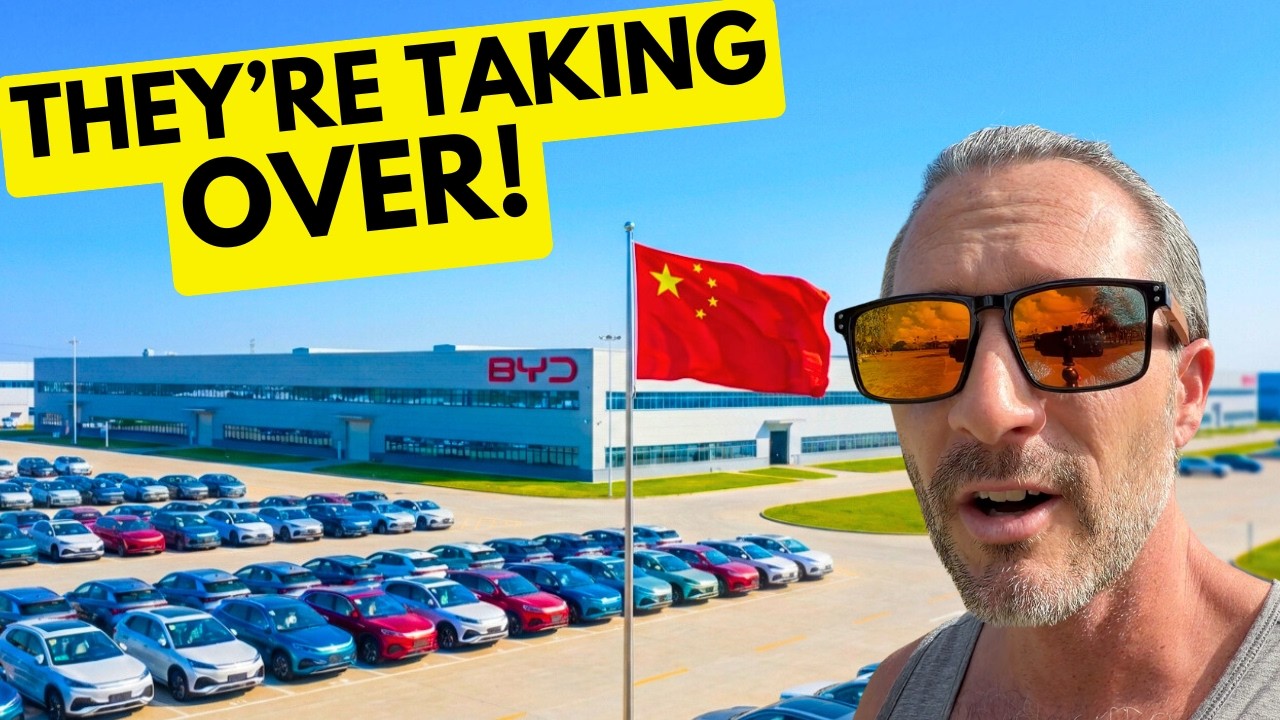
OUT OF BUSINESS! America's Auto Industry is DONE

Channel: Michael Bordenaro Published: 2026-02-18 16:02
Michael Bordenaro

The speaker argues that Chinese automakers, especially in EVs, are becoming a major threat to U.S. automakers because of heavy subsidies, cheap labor, and control of key supply chains. He says U.S. incumbents like Stellantis, Ford, and GM are weakened by costly EV strategies, making tariffs and protectionism a temporary shield for American jobs and domestic industry.

Watch on YouTube ›

Get the market thesis, key claims, assets, contradictions, and follow-up questions from any financial video — then unlock a version personalized to your portfolio, watchlist, and favorite speakers.

Detailed summary

This video is a polemical warning that the American auto industry is under structural pressure from China’s cost advantage and from its own strategic mistakes. The speaker says Chinese automakers benefit from state subsidies, near-zero financing, and very low labor costs, allowing them to sell vehicles far cheaper than U.S. competitors. He argues that tariffs and import restrictions are currently the main barrier preventing Chinese brands from overwhelming the U.S. market, and he frames those protections as economically painful but necessary to preserve jobs, dealerships, suppliers, and the broader industrial base. He then broadens the warning beyond price competition. He says Chinese EVs are already gaining share abroad, citing Europe and Canada as examples, and suggests Canada could become a backdoor into the U.S. market because of integrated supply chains and geographic proximity. …

🔒 The full detailed summary continues — read all of it free with an account. Read the full summary →

Main takeaways

  1. China’s auto industry is framed as a price-disrupting threat powered by subsidies, cheap labor, and scale.
  2. Tariffs are presented as a necessary but imperfect shield for U.S. auto jobs and suppliers.
  3. Stellantis is used as evidence that legacy automakers are under strain from EV losses and weak demand.
  4. The speaker believes U.S. consumers prefer affordable hybrids and conventional cars over premium EVs.
  5. The long-run risk is that Chinese EV makers gain footholds abroad and eventually pressure the U.S. market as well.

Market read by horizon

Short term

Tactically, the setup is defensive for U.S. auto names: tariff protection and political barriers still matter, but any easing of trade friction or North American leakage through Canada would be a near-term negative for incumbents. Near-term attention should stay on EV demand updates, restructuring headlines, and whether legacy OEMs can keep margins from deteriorating further.

  • Tariffs and import restrictions are the immediate line of defense against Chinese EV penetration into the U.S.
Show more
  • Canada is flagged as a possible near-term entry point for Chinese EVs into North America.
  • The speaker is watching whether Stellantis can stabilize after announcing restructuring and a large debt increase.
Mid term

Over the next few months, the likely path is continued de-emphasis of pure EV expansion in favor of hybrids, lower-cost trims, and profitability-first product planning. The view would be challenged if EV adoption rebounds materially, if Chinese export growth stalls outside China, or if legacy automakers show sustained margin recovery.

  • Over the next several months, the speaker expects the U.S. auto industry to keep retreating from aggressive EV expansion if consumer demand stays weak.
Show more
  • A stronger base case in the speaker’s view is a shift toward hybrids, lower-priced vehicles, and more traditional powertrains.
  • If Chinese EV brands continue gaining share in Europe and neighboring markets, pressure on U.S. automakers could intensify.
Long term

Structurally, the video argues that auto leadership will belong to the players that control cost, batteries, and supply chains rather than the brands with the biggest legacy footprint. The long-run implication is that Western automakers may survive only by narrowing their product scope and matching consumer affordability, while Chinese manufacturers remain the marginal price-setters globally.

  • The durable thesis is that industrial policy and supply-chain control can reshape global auto competition for years, not just quarters.
Show more
  • If Chinese automakers sustain subsidy-supported market share gains, they could become a lasting structural competitor to Western carmakers.
  • The speaker implies the auto industry’s future will be determined by affordability, manufacturing scale, and control of batteries and minerals more than brand prestige.
Unlock the full horizon read See the full short-term, mid-term, and long-term implications with confirmation and invalidation signals. Unlock horizon read

Key claims (9)

BEARISH global auto competition U.S. auto industry

Chinese automakers are becoming a serious threat to the survival of American automakers.

Central thesis repeated throughout the video.

BULLISH industrial policy Chinese auto industry

Chinese automakers have a major cost advantage because of subsidies, cheap capital, and low labor costs.

Speaker repeatedly cites government support and labor differences as the reason for Chinese pricing power.

BULLISH trade policy U.S. auto industry

Tariffs and import restrictions are currently shielding U.S. automakers from Chinese competition.

He explicitly calls tariffs a protective shield.

Unlock 6 more claims See the full bullish, bearish, and counter-consensus argument map extracted from the transcript. Unlock all claims

Assets discussed (8)

Ford — F
MIXED stock

Used as an example of a U.S. automaker suffering from EV losses and quality/strategy problems, but also improving initial quality and paying bonuses.

General Motors — GM
BEARISH stock

Mentioned as another U.S. automaker losing billions on EVs and facing the same competitive pressure.

Unlock the full asset map (6 more) See all assets mentioned, their directional bias, and the exact reasoning. Unlock asset map

Where this transcript pushes against consensus

  • The claim that Chinese automakers would put all domestic automakers out of business “overnight” is highly exaggerated and unsupported.
  • The video treats tariffs as clearly beneficial despite acknowledging they raise consumer prices; the tradeoff is asserted more than demonstrated.
  • Safety claims about Chinese EVs rely on anecdotal reports of fires and defects rather than comparative data.
  • The speaker assumes low EV adoption is mainly preference-driven, but price, charging access, and model availability are only partially analyzed.
  • The argument that subsidies alone explain Chinese EV competitiveness underweights scale, industrial learning, and supply-chain integration.

Topics

Chinese EV subsidiesU.S. auto industryTariffs and protectionismStellantis restructuringFord losses and bonusesEV adoption barriersHybrid vehiclesCanada as backdoor marketEuropean auto competitionBattery and critical mineral supply chains

Create your free research agent

Unlock the full claims, asset map, scores, related transcripts, follow-up questions, and AI chat — shaped around your portfolio, watchlist, favorite speakers, and risks.

  • Full claims and asset map
  • Personalized relevance to your watchlist
  • Follow-up questions you can track
  • Related transcripts from your workspace
  • AI chat about this video
Create your free research agent
TRANSCRIPTAGENT.AI