
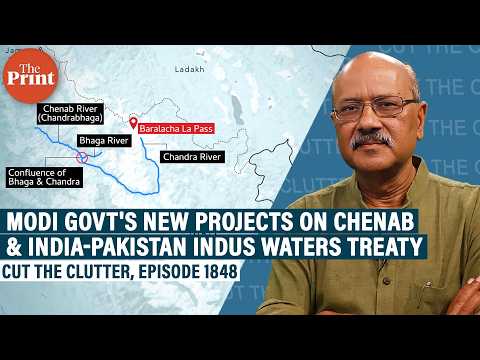
This episode argues that India’s move to put the Indus Waters Treaty in abeyance after the Pahalgam attack has shifted the water dispute with Pakistan from a legal/theoretical issue into active state policy. The speaker says India is not yet blocking Pakistani water, but is now fast-tracking run-of-river and desilting projects on the Chenab system—especially in Jammu and Kashmir and Himachal Pradesh—that he считает are within India’s rights and mostly too small to materially reduce downstream flows.
Watch on YouTube ›Get the market thesis, key claims, assets, contradictions, and follow-up questions from any financial video — then unlock a version personalized to your portfolio, watchlist, and favorite speakers.
The core thesis is that the Chenab-related projects announced by India are not a dramatic attempt to “choke” Pakistan, but a practical assertion of rights that India has long been prevented from exercising under the Indus Waters Treaty. The speaker frames the current controversy as a reaction to the Pahalgam massacre and to India placing the treaty “in abeyance,” not cancellation. In his view, that move frees India to stop treating Pakistani objections as a veto over Indian hydroelectric and water-management projects, while still not actually stopping water from reaching Pakistan. He spends much of the video explaining the treaty architecture: the western rivers—Indus, Jhelum, and Chenab—were allocated largely to Pakistan, while the eastern rivers—Ravi, Beas, and Sutlej—were allocated to India. …
Near term, the setup is political escalation around India’s Chenab projects, with the main risk being legal, diplomatic, or sabotage-related pushback rather than a large immediate water shock.
Over the next few months, the base case is continued Indian construction and growing normalization of treaty-defying rhetoric, unless court action, security incidents, or policy reversals slow execution.
Structurally, the video argues the treaty regime is no longer sacrosanct: water infrastructure in the western rivers is becoming a strategic lever, and future India-Pakistan relations may be shaped more by control of catchments and projects than by the old goodwill model.
India has put the Indus Waters Treaty in abeyance after the Pahalgam massacre rather than cancelling it.
The speaker distinguishes between suspension and repeal, and links the move to the attack.
The treaty gave Pakistan rights to almost all of the western rivers while India retained only a small share of storage and use rights.
He explains the treaty split and says India only had about 3% of this water for storage/use.
India has not been able to build storage on western rivers mainly because Pakistani objections trigger arbitration and delay.
He says objections lead to litigation and international arbitration, creating an endless process.
Unlock the full claims, asset map, scores, related transcripts, follow-up questions, and AI chat — shaped around your portfolio, watchlist, favorite speakers, and risks.
