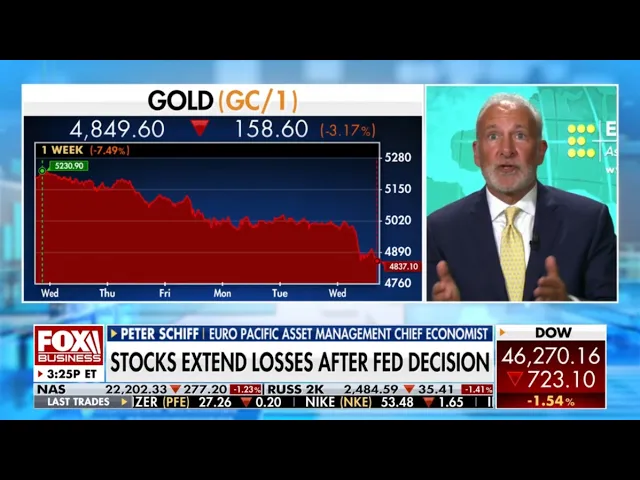
Peter Schiff argues Powell and the Fed are badly behind the curve: inflation is still accelerating, the economy is more fragile than officials admit, and higher rates are needed but politically impossible. Nathan Sheets pushes back that the Fed sees manageable growth, with risks centered on oil, Iran, and a weak housing sector rather than an imminent crash.
Watch on YouTube ›Get the market thesis, key claims, assets, contradictions, and follow-up questions from any financial video — then unlock a version personalized to your portfolio, watchlist, and favorite speakers.
This is a TV-style market discussion reacting to the Fed chair’s press conference and a sharp equity selloff. The host frames the debate around whether markets are reacting to Powell’s comments on inflation, oil shocks, and growth. Nathan Sheets, speaking from a more conventional Fed-aligned perspective, says Powell acknowledged real risks: uncertainty around Iran and oil, inflation pressure, and a soft jobs market, but still expected the economy to land in an okay place. Peter Schiff rejects that framing entirely, arguing the Fed misunderstands both inflation and the real economy. He says the hotter-than-expected PPI shows inflation is reaccelerating, that the Fed should be hiking by far more than 25 bps, and that prior cuts were mistakes. …
Near term, this is a risk-off setup with gold/miners favored if oil and inflation stay hot, while housing-linked equities and broad US financial assets remain vulnerable.
Over the next few months, the decisive variable is whether inflation and housing weakness force the market to reprice a more hawkish or at least less accommodative Fed. If growth stays resilient and oil fades, the bearish case loses urgency; if not, Schiff’s stagflation view gains credibility.
Structurally, Schiff is arguing for a stagflation regime driven by debt, war finance, and Fed constraints, which would be bullish for precious metals and bearish for fiat assets and bonds. The opposing structural view is a still-functional US economy supported by consumer demand, AI capex, and corporate efficiency despite soft pockets like housing.
Powell emphasized uncertainty around Iran and oil prices as a major risk to the economy.
Nathan Sheets summarizes Powell's press conference as centering on Iran and oil price uncertainty.
Powell and the FOMC were prepared to do what was necessary to hit the 2% inflation target.
Nathan Sheets characterizes Powell as reaffirming the Fed's inflation target commitment.
The February producer price index was hotter than expected and supports the view that inflation is reaccelerating.
Schiff cites the PPI print as the reason gold sold off ahead of the Fed announcement and as evidence of inflation pressure.
What do you think the markets are trying to get out of their system that they dislike the most?
Nathan Sheets says Powell clearly identified the key risks: Iran, oil, inflation, and a weak jobs market, while still thinking the economy can land in an okay place.
What do you think about Powell's assessment of the oil shock and how do you think it's going to work its way through the economy?
Schiff says the Fed misunderstands the economy and inflation, points to hotter PPI, argues every rate cut since 2023 was a mistake, and says the economy is headed for recession.
Where are they getting that number?
Nathan Sheets says the 2.4% GDP outlook reflects a resilient economy supported by consumer strength, AI investment, and a lean, globally competitive corporate sector.
Unlock the full claims, asset map, scores, related transcripts, follow-up questions, and AI chat — shaped around your portfolio, watchlist, favorite speakers, and risks.