TranscriptAgent
Try it free
TRANSCRIPTAGENT.AI · transcript analysis

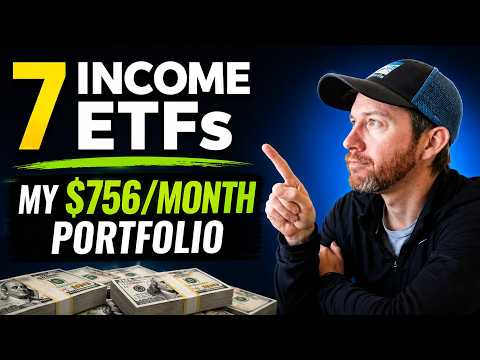
My 7 ETF Income Portfolio Generating $756/Month: Here's How

Channel: The Frugal Expat Published: 2026-06-19 05:45
The Frugal Expat

Steve from The Frugal Expat walks through his seven-ETF income portfolio, which he says is about $41.5k and generates roughly $756/month. The portfolio mixes high-yield option-income ETFs, a Bitcoin/gold income ETF, a leveraged Nasdaq-income product, an income overlay on the S&P 500, and a dividend international ETF, with the stated goal of compounding income now and eventually replacing work income later.

Watch on YouTube ›

Get the market thesis, key claims, assets, contradictions, and follow-up questions from any financial video — then unlock a version personalized to your portfolio, watchlist, and favorite speakers.

Detailed summary

This video is a personal portfolio breakdown rather than a macro forecast. Steve says he is building a small income sleeve inside a broader portfolio that also holds VTI, QQQM, VGT, VXUS, and growth stocks. His core thesis is straightforward: use a mix of high-yield and dividend-oriented ETFs to generate current cash flow, reinvest it, and eventually build a stream that could replace earned income. He emphasizes this is educational content, not financial advice. He starts with CHIPY, the YieldMax Semiconductor Portfolio Option Income ETF, which he frames as a high-yield semiconductor income vehicle using covered calls on semiconductor holdings. He says it holds roughly 15-30 semiconductor names and mentions Nvidia, Broadcom, Marvell, Lam Research, ASML, Micron, and Intel. …

🔒 The full detailed summary continues — read all of it free with an account. Read the full summary →

Main takeaways

  1. The portfolio is built for current income first, with reinvestment as the main compounding engine.
  2. Steve mixes aggressive option-income ETFs with one traditional dividend ETF to diversify income sources.
  3. He is comfortable taking on NAV erosion and leverage risk in exchange for higher distribution yields.
  4. The biggest positions and strongest conviction are in Nasdaq-linked income products, especially XQQI and QQQI.
  5. He sees Bitcoin/gold, semiconductors, and space as thematic satellites around a core income framework.
  6. The portfolio is not meant to replace wages yet, but to grow toward that goal over time.

Market read by horizon

Short term

Tactically, the portfolio is positioned for continued income generation if volatility stays elevated and the favored themes hold up; the immediate risk is drawdown or distribution compression in the higher-octane ETFs.

  • Near-term, the key setup is the portfolio’s very high distribution rate, with monthly income stated at about $756 and several weekly payers.
Show more
  • Watch for drawdowns or NAV erosion in the YieldMax-style semiconductor sleeve and the leveraged Nasdaq-income sleeve if markets weaken.
  • The immediate catalyst for performance is continued volatility and stable-to-rising prices in semis, tech, Bitcoin, gold, and space names.
Mid term

Over the next few months, the setup works best if Nasdaq, semis, and alternative assets keep contributing while distributions stay stable; if volatility fades or one theme breaks, the portfolio may need rotation into more durable income sleeves.

  • Over the next several weeks to months, the base case is continued reinvestment of distributions to build a larger income base.
Show more
  • The portfolio works best if semiconductors, Nasdaq leaders, Bitcoin, gold, and space equities each contribute at different times rather than all depending on one factor.
  • Confirmation would come from distributions staying durable while underlying NAVs remain reasonably stable.
Long term

Structurally, the video argues that income can be manufactured from broad equity exposure through option overlays, but the long-run regime question is whether those yields justify the hidden costs in upside caps, leverage, fees, and NAV erosion.

  • Structurally, the video argues that an income portfolio can be assembled from option overlays, not just traditional dividends.
Show more
  • The long-run implication is a shift from pure growth accumulation toward cash-flow compounding and partial income replacement.
  • His framework assumes investors can tolerate lower upside participation and some principal decay in exchange for cash yield.
Unlock the full horizon read See the full short-term, mid-term, and long-term implications with confirmation and invalidation signals. Unlock horizon read

Key claims (8)

BULLISH Nasdaq 100 QQQI

QQQI is a tax-efficient Nasdaq 100 covered-call ETF that yields about 13% to 15% and is one of the speaker's favorite income funds.

He argues the fund's 1256-contract structure makes distributions tax efficient while still providing high income and some growth exposure.

BULLISH

The portfolio currently produces about $756 per month in income, and the speaker expects that income to grow enough to support living expenses in the future.

He says the current monthly income is $756 and frames the portfolio as a future replacement for earned income.

BULLISH Nasdaq 100 XQQI

XQQI is a leveraged, higher-yield version of QQQI that targets 150% notional exposure to the Nasdaq 100 and carries more drawdown risk.

He explains that the fund uses a boosted structure to increase exposure and yield, while also warning it can fall more in a downturn.

Unlock 5 more claims See the full bullish, bearish, and counter-consensus argument map extracted from the transcript. Unlock all claims

Assets discussed (35)

VTI — VTI
NEUTRAL etf

Held as part of the broader portfolio outside the income sleeve.

QQQM — QQQM
NEUTRAL etf

Held as part of the broader portfolio outside the income sleeve.

Unlock the full asset map (33 more) See all assets mentioned, their directional bias, and the exact reasoning. Unlock asset map

Speakers

SPEAKER Steve Cummings GUEST Steve

Where this transcript pushes against consensus

  • The video gives little evidence that the highest-yield ETFs will preserve capital over long periods; high distributions may come with NAV drag.
  • Claims that some ETFs have beaten benchmarks since inception are presented without deeper context on starting dates, regime dependence, or risk-adjusted returns.
  • The bullish case for SPCI, Bitcoin, gold, and semiconductors is more thematic than analytical and depends heavily on future price appreciation.
  • XQQI is described as a leveraged winner, but the long-term tradeoff between extra yield and deeper drawdowns is only briefly acknowledged.
  • The portfolio is framed as diversified, but several holdings are still highly correlated to risk assets and market volatility.
  • The sponsor segment for stockanalysis.com interrupts the investment narrative and is not directly tied to the portfolio thesis.

Topics

income portfolio constructionoption-income ETFsYieldMax semiconductor incomeBitcoin and gold ETFleveraged Nasdaq incomespace industry ETFtax-efficient distributionsS&P 500 overlay strategyinternational dividend exposureportfolio risks and NAV erosion

Create your free research agent

Unlock the full claims, asset map, scores, related transcripts, follow-up questions, and AI chat — shaped around your portfolio, watchlist, favorite speakers, and risks.

  • Full claims and asset map
  • Personalized relevance to your watchlist
  • Follow-up questions you can track
  • Related transcripts from your workspace
  • AI chat about this video
Create your free research agent
TRANSCRIPTAGENT.AI