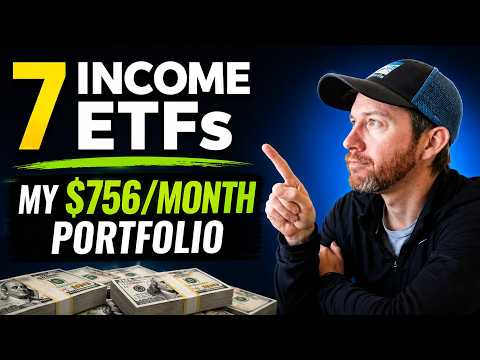
An interview with Michael Brownstein of My Retirement Trading about building retirement income from covered-call and overlay ETFs. He explains why his portfolio centers on a few income funds tied to the S&P 500 and Nasdaq, while keeping some growth exposure and cash reserves.
Watch on YouTube ›Get the market thesis, key claims, assets, contradictions, and follow-up questions from any financial video — then unlock a version personalized to your portfolio, watchlist, and favorite speakers.
This is an interview-style conversation between Steve and Michael Brownstein focused on income ETFs, retirement planning, and the tradeoffs between yield, growth, and risk. Michael says he is 55, runs the YouTube channel My Retirement Trading, and has evolved from traditional index investing into a portfolio centered on covered-call and option-overlay funds. His core thesis is that a diversified mix of income ETFs can generate enough cash flow to fund retirement sooner, while still leaving room for long-term market participation. He traces his investing path from an early Walmart purchase to years in a “balanced” 401(k) fund that he says underperformed badly, then to reading Tony Robbins’ book and embracing Jack Bogle-style index investing, especially the S&P 500. …
Tactically, the setup is still pro-risk and pro-tech, with the speaker using distributions to buy more of the higher-yielding funds on dips. Near-term risk is a pullback in Nasdaq-heavy holdings or disappointment from newer themed products.
Over the next few months, the base case is that income ETFs remain a workable bridge as long as large-cap growth holds up and distributions stay dependable. If tech leadership breaks or premiums compress, he would likely rotate again rather than abandon the strategy.
Structurally, the conversation argues that retirement income can be built from equity-option overlays on top of index exposure rather than from traditional bond-heavy portfolios. The durable regime assumption is continued dominance of large-cap U.S. tech and enough option premium to make the cash-flow model attractive.
The speaker has shifted the core of his portfolio into income ETFs, which now make up roughly 60% or more of his holdings.
He says he has mostly moved into income funds and estimates they are about 60% of his portfolio, with the remainder in growth ETFs.
He prefers Nasdaq-100 exposure because he believes technology and AI will continue to grow and is using that preference to justify heavier allocations to Nasdaq-linked income funds.
He explicitly says he is big into technology and AI, uses these in daily life, and does not believe technology is going away, which is why he favors Nasdaq-focused funds.
The speaker expects his income portfolio to generate about $60,000 to $62,000 annually over the next 12 months.
He says his covered-call and income ETF portfolio is currently projected to produce that amount over the next year.
What happened with your 401(k), and what was the result of moving into an S&P 500 index fund?
Michael says the balanced fund in his 401(k) was a poor choice and left him with about $150,000 after 22 years. When he later got access to an S&P 500 index fund, his life changed immediately and that account later grew to about 5x after rolling it into an IRA.
Can you introduce yourself and explain your YouTube channel and investing background?
Michael Brownstein says he runs the YouTube channel My Retirement Trading and is 55 years old. He describes starting investing in his early 20s, then moving through a long 401(k) experience, eventually learning index-fund investing and later income funds.
How did you get started investing, and what changed your approach?
He says his first investment was 40 shares of Walmart in his early 20s, but family obligations forced him to stop. Later, a long stretch in a balanced 401(k) fund produced disappointing results, and reading Tony Robbins' book shifted him toward Jack Bogle-style index investing.
Unlock the full claims, asset map, scores, related transcripts, follow-up questions, and AI chat — shaped around your portfolio, watchlist, favorite speakers, and risks.