
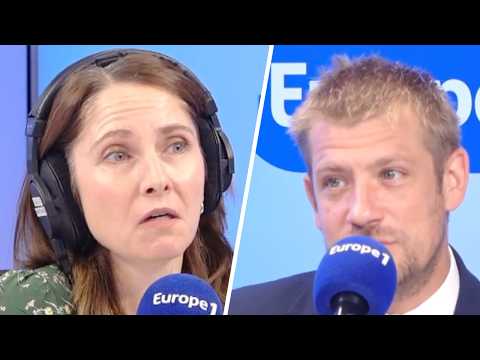
This is a political interview on Europe 1, not a market video. Romain Eskenazi, speaking as a PS deputy and spokesperson, argues for climate-adaptation spending, more public investment, and a mix of budget discipline and tax reform rather than large cuts to public services. He also supports a tightly constrained end-of-life law and endorses broader social policies like school vacations to increase mixité.
Watch on YouTube ›Get the market thesis, key claims, assets, contradictions, and follow-up questions from any financial video — then unlock a version personalized to your portfolio, watchlist, and favorite speakers.
This transcript is an interview on Europe 1 centered on domestic policy, public spending, justice, climate adaptation, and the end-of-life bill. Romain Eskenazi presents a broadly social-democratic line: France must adapt to heat waves with insulation and selective air-conditioning in schools and public buildings, but the real priority is not “climatiser everything”; it is to combine transition, adaptation, and public investment. He repeatedly argues that climate policy cannot be reduced to ideology and that the country needs a serious investment plan backed by public spending over time. On the budget debate, he pushes back against the idea that France can solve its fiscal issues mainly by cutting public services. …
No actionable market setup here; the only immediate policy read is that heatwaves are pushing the French debate toward emergency adaptation spending and workplace rules. For markets, the tactical implication would be more about public-sector spending pressure than any tradable asset signal.
Over the next few months, the likely path is continued political pressure for climate adaptation, justice staffing, and social spending, which supports a higher-spending policy mix rather than austerity. The key validation signal would be whether the government funds targeted adaptation and justice capacity instead of relying on symbolic cuts.
Structurally, the transcript points to a more interventionist French state that must finance climate resilience, public institutions, and social cohesion over time. The long-run regime implication is persistent pressure for higher public investment and progressive taxation, with less room for ideological austerity.
The French state should make a massive public investment in ecological transition and adaptation rather than treating it as a discretionary expense.
The speaker says economic growth and employment should rest on large-scale investment in energy transition, building insulation, and climate adaptation.
The proposed end-of-life law is extremely constrained and only applies under strict conditions.
The speaker says the text requires adulthood, French nationality, terminal illness, no chance of recovery, unbearable suffering, multiple medical validations, and a reconfirmation period.
The speaker argues that France has a systemic justice problem because the law is not adapted to new forms of sexual violence and because the justice system lacks sufficient resources.
They cite the Liana case as revealing long-known gaps, then point to the number of judges, prosecutors, and untreated rape cases as evidence of structural failure.
Why is France so poorly adapted to heatwaves compared with other countries, and is climate denial partly to blame?
The guest says France also pays the price of a denialist attitude toward global warming, with some people treating climate policy as non-priority for the past decade. They argue the country needs massive investment in adaptation and ecological transition, including insulation and climate-control in buildings.
Where can the state make cuts without sacrificing essential public services?
The guest says there are some savings to find, especially in management practices, consulting firms, and possibly some agencies that may not be useful. But they reject the idea that tens of billions can be found by cutting public services, and say there is no magic money in ecological transition.
Are you in favor of a climate leave when conditions are extreme?
He says he is not against the principle, though he thinks the term 'climate leave' is not the best way to frame it. He supports adapting labor law so workers who must stay home because schools are closed or conditions are extreme do not lose pay or an entire day off.
Unlock the full claims, asset map, scores, related transcripts, follow-up questions, and AI chat — shaped around your portfolio, watchlist, favorite speakers, and risks.
