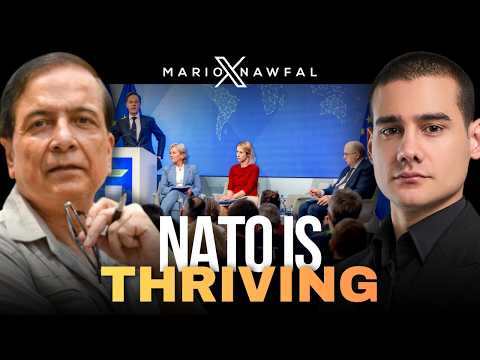
Anas Alhajji explains that the Strait of Hormuz crisis is fundamentally about control, not fees. A Singaporean vessel was struck by IRGC elements, possibly fringe actors operating outside government coordination. Alhajji argues Iran legally distinguishes between "tolls" (which Trump opposes) and "service charges" (which could be justified under international law). However, Iran cannot unilaterally impose service charges without an international agreement. He also analyzes why oil prices collapsed from $170+ levels: China slashed imports by ~6M bpd rather than pay high prices, used floating storage, boosted domestic production, and banned petroleum product exports. A key nuance: as long as China only imports Iranian oil, prices won't rise — China must buy from other nations for prices to recover. Japan's SPR depletion is an exchange-rate problem, not a supply one.
Watch on YouTube ›Get the market thesis, key claims, assets, contradictions, and follow-up questions from any financial video — then unlock a version personalized to your portfolio, watchlist, and favorite speakers.
Anas Alhajji joined Mario Nawfal to discuss the escalating situation in the Strait of Hormuz, where a Singapore-flagged vessel was struck by IRGC forces hours before the interview. The incident unfolded after Oman, under apparent US pressure, established temporary IMO-coordinated maritime corridors on June 23rd — a move Iran's IRGC immediately rejected as "unacceptable and completely dangerous." Ships that attempted the new corridor reportedly turned back after receiving warnings from Iranian forces. Alhajji's core thesis is that the Hormuz dispute is not about money or fees but about **control** — specifically, the principle that ships would need Iranian permission to transit. He drew a critical legal distinction: Trump has repeatedly promised "no tolls," but Iran has never demanded tolls. …
Cautious/bearish on oil near-term: the Hormuz strike is likely a one-day event that fades, and as long as China only imports Iranian oil, no price catalyst exists. The risk is asymmetric to additional strikes rather than supply disruption.
Conditional on China's buying behavior: if the US-Iran deal holds and China resumes broad imports (not just Iranian barrels), oil prices recover. If China stays Iran-only, prices stay suppressed. Japan's demand remains absent until yen strengthens.
Structural uncertainty: the US-Iran-China triangle is being renegotiated fundamentally — the outcome determines whether Iran becomes a US-aligned Gulf stabilizer or remains in China's orbit. The strait-control precedent risk is systemic for global shipping, not just oil.
Iran cannot legally charge tolls for the Strait of Hormuz because it is a natural waterway, and Trump cannot grant them that privilege without an international agreement.
The speaker distinguishes between tolls (illegal for natural waterways) and service charges (which require an international agreement like Turkey's), arguing Iran cannot achieve this unilaterally.
The decline in oil prices after the Hormuz crisis was driven primarily by Chinese demand destruction (reduced imports by ~6M bpd) rather than the supply restoration that most analysts focused on.
Speaker argues analysts overestimated the supply shortfall while ignoring that Chinese buyers refused to pay high prices and slashed imports, which collapsed demand and erased the shortage.
The IRGC struck one Singaporean-flagged vessel in the Strait of Hormuz after issuing warnings.
The speaker cites a Wall Street Journal report according to US officials that the IRGC hit a vessel.
What happened with the new maritime corridor in the Strait of Hormuz today, and why is it controversial?
The guest says Oman issued a navigation warning creating two temporary IMO-coordinated corridors, but Iran rejected the corridor as unacceptable and dangerous. He adds that a vessel was reportedly struck and that the situation reflects an ongoing power struggle in the strait.
Why do you say this is really about control rather than the size of the fee?
He says the amount of the fee is not the real issue; the real issue is control and permission to pass through the strait. Even a token fee would still mean the ships are being allowed through by the controlling party, which matters to the GCC states.
Are the U.S. and Iranian claims about tolls and service charges actually the same thing?
The guest argues the administration was only rejecting tolls, not service charges, and says the two are legally different. He explains that a service charge could cover navigation guidance or dredging, but says Iran cannot impose that arrangement unilaterally.
Unlock the full claims, asset map, scores, related transcripts, follow-up questions, and AI chat — shaped around your portfolio, watchlist, favorite speakers, and risks.