
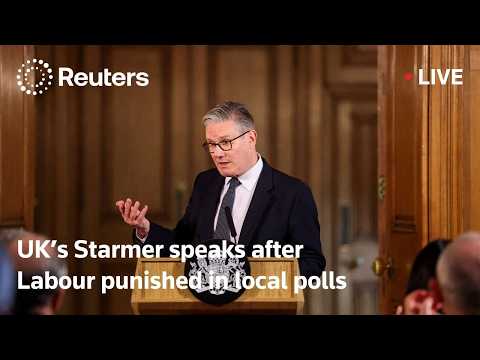
Reuters aired Keir Starmer responding to Labour’s poor local election results by framing the setback as a mandate to change course, move faster, and argue more forcefully for Labour values. He emphasized responsibility, rejected resignation, and announced a move toward public ownership of British Steel, closer EU ties, and a tougher message on immigration, security, and community cohesion.
Watch on YouTube ›Get the market thesis, key claims, assets, contradictions, and follow-up questions from any financial video — then unlock a version personalized to your portfolio, watchlist, and favorite speakers.
This is a live Reuters political transcript, not a market segment, but it still has clear macro-policy implications. The main speaker is UK Prime Minister and Labour leader Keir Starmer, introduced by Labour MP Jade Botrell. Botrell opens by describing her own experience campaigning in Wakefield and the emotional impact of Labour losses, then frames Starmer as the leader who can still deliver on Labour values. Starmer follows with a lengthy political defense after Labour was punished in local elections. He says the results were “tough,” accepts responsibility, but insists he will not walk away and will not repeat the leadership chaos of the Conservative years. Starmer’s core argument is that the political environment has changed and that incremental change is no longer enough. He says the government must respond with a larger, more urgent agenda on growth, defense, Europe, and energy. …
Near term, this reads as a stabilization attempt: Starmer is trying to shut down leadership chatter and project control with a symbolic industrial-policy move and a pro-Europe reset. The immediate risk is that the more he emphasizes urgency, the more visible Labour’s internal weakness becomes.
Over the next few weeks to months, the likely path is a tougher, more interventionist Labour message paired with selective policy actions on industry and Europe. That can help if it turns into visible delivery, but the setup remains vulnerable until polling and party discipline improve.
Longer term, the speech points to a Labour government trying to embed a more state-capacity-heavy, strategically interventionist model for the UK. The structural question is whether Britain settles into a higher-public-role, closer-Europe, industrial-renewal regime or whether credibility problems prevent that shift.
The local election results were bad enough that Labour needs a bigger response than originally planned in 2024.
Starmer said the world is different now and incremental change will not cut it.
Starmer will not resign and says leadership churn would damage the country.
He repeatedly rejected walking away and cited the Conservative record of leadership changes as harmful.
The government will bring forward legislation this week to take full national ownership of British Steel, subject to a public interest test.
He explicitly announced forthcoming legislation and framed it as public ownership in the public interest.
Do you think what you've said this morning is enough, and what do you say to colleagues considering whether to support you or to push you to go?
He says he is setting out the response and direction the country needs, arguing that the world is different now and requires a bigger response than 2024. He frames the task as change that Labour was elected to deliver, not a return to the status quo.
Will you continue blocking Andy Burnham from trying to return to Parliament?
He says any future decision rests with the NEC. He adds that Andy Burnham is doing a great job as mayor of Manchester and that they work well together on issues like Northern Powerhouse Rail and Manchester's response to a synagogue attack.
Did you ever consider resigning as Labour leader after these results, and if not, why not?
He says the chaos of constantly changing leaders in the last government cost the country a huge amount, especially working people. He uses that as the reason he is not stepping aside.
Unlock the full claims, asset map, scores, related transcripts, follow-up questions, and AI chat — shaped around your portfolio, watchlist, favorite speakers, and risks.
