
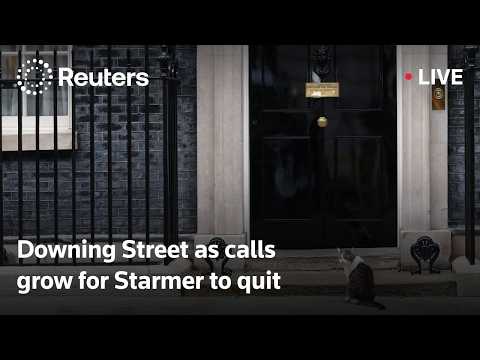
Reuters’ live Downing Street coverage focused on mounting pressure for Keir Starmer to resign after poor election results, with a cabinet meeting underway and the first ministerial resignation arriving during the broadcast. The piece emphasized Labour’s internal split, uncertainty over a formal leadership challenge, and the immediate political and market fallout.
Watch on YouTube ›Get the market thesis, key claims, assets, contradictions, and follow-up questions from any financial video — then unlock a version personalized to your portfolio, watchlist, and favorite speakers.
This live video is political event coverage from outside Downing Street, centered on a fast-moving Labour leadership crisis. The broadcast repeatedly asks whether Keir Starmer should resign, whether he has lost the confidence of his cabinet and MPs, and whether a formal challenge to his leadership is imminent. The central development is the resignation of communities minister Miatta Fahnbulleh, who called on Starmer to set out a timetable to go. The reporters also note that a number of MPs are publicly urging him to resign, while other senior figures, including Steve Reed and others named in the feed, are still backing him and arguing that a leadership fight would create instability. A key quoted message from Starmer, delivered at the cabinet meeting, is that he takes responsibility for the election results and for delivering the promised change, but that the Labour Party’s formal …
Tactically, this is a headline-risk event: further resignations or a public break from a senior minister could force a sharper repricing of the leadership odds. Until then, the trade is volatility and fast-moving UK political news flow.
Over the next several weeks, Starmer either stabilizes the party by holding cabinet support together or faces a more organized challenge if the rebel count keeps rising. Confirmation would come from reduced resignations and coordinated backing; invalidation would be a broadened anti-leadership bloc.
Structurally, the episode points to a fragile governing environment in the UK, where party splits can undermine a newly elected leader quickly. The longer-run implication is a higher baseline of political risk and policy uncertainty, even without another election.
Starmer told cabinet he takes responsibility for the election results and for delivering the promised change.
Directly quoted in the live report from the cabinet meeting.
The Labour Party’s formal leadership challenge process has not been triggered.
This was presented as Starmer’s procedural defense to the cabinet.
The first ministerial resignation materially escalated pressure on the prime minister.
The feed repeatedly says the resignation of Miatta Fahnbulleh was significant and timed just before the cabinet meeting.
Should the prime minister resign?
Guests and ministers mostly avoided a direct yes/no answer on air, with some stressing support for the prime minister and others implying he should go.
Is it over for Kiamer?
The broadcast used this as a repeated shouted question rather than a formal interview prompt; the live response was that the prime minister is trying to force challengers to act if they want to remove him.
Unlock the full claims, asset map, scores, related transcripts, follow-up questions, and AI chat — shaped around your portfolio, watchlist, favorite speakers, and risks.
