Keen’s recurring economic worldview is that capitalism is inherently unstable, that mainstream equilibrium-based economics is fundamentally misleading, and that private debt and…
Preview how this speaker shows up across market transcripts. Unlock the full archive, AI chat, and the version personalized to your watchlist, followed channels, and favorite speakers.
Steve Keen is a heterodox economist best known for criticizing mainstream macroeconomics and for predicting the 2008 Global Financial Crisis. Across the supplied material he presents himself as a systems-oriented analyst who uses double-entry bookkeeping and financial-sector modeling to explain how money, debt, and banks actually work. He repeatedly argues that conventional economics obscures the real structure of the economy, especially by treating banks as mere intermediaries and by ignoring private debt, monetary creation, and balance-sheet effects. He also frames himself as a teacher and explainer, offering books, courses, software (Revel/Ravel), and podcast/video series to spread his approach.
Keen’s recurring economic worldview is that capitalism is inherently unstable, that mainstream equilibrium-based economics is fundamentally misleading, and that private debt and bank credit creation are central drivers of booms, busts, and financial crises. He rejects the household analogy for government finance, argues that government deficits are not the same as household borrowing, and emphasizes that state spending, taxes, bonds, and reserves must be understood through accounting rather than simplistic flowcharts. He also repeatedly warns that neoliberal policy has increased insecurity, worsened inequality, weakened public services, and helped produce stagnant wages, precarious work, and social stress. In the later materials, he extends this systems critique to health, burnout, climate, food systems, and ecological limits, arguing that the economy is embedded in physical reality and cannot be treated as independent of energy or the planet. Overall, he favors public spending for social needs, job stability, and economic resilience, while opposing policy framed around arbitrary debt fears or austerity logic.
Every analyzed appearance we have for this speaker, newest first. Open any transcript preview to read the underlying transcript.
Preview:Professor Steve Keen argues that modern economies run on private debt creation, that growth only became possible with fossil fuels, and that we have crossed from productive debt (financing innovation) into speculative debt (bidding up asset prices). He proposes a "modern debt jubilee" to write down excessive private debt, particularly mortgage debt, which he calls a "death contract" that has enslaved rather than liberated people.
Preview:Prof. Steve Keen critiques a commentator's analysis of the US debt situation, arguing that conventional "flowchart thinking" confuses the primary and secondary bond markets. He uses his Ravel double-entry bookkeeping software to demonstrate that government deficits create the reserves banks use to buy bonds at primary auctions. Because the Fed sets reserve rates below bond yields, primary auctions are always oversubscribed regardless of secondary-market yields. Keen concludes that foreign selling of Treasuries on the secondary market won't trigger a US government funding crisis.
Preview:Professor Steve Keen argues that the post-WWII stability era was deliberately dismantled by neoliberal economics starting around 1974, creating permanent economic insecurity that manifests physically as burnout and chronic stress. He predicts a systemic collapse within 1-2 decades driven by climate change that will make the GFC "look like a picnic." The conversation links macroeconomic instability to human biology, food systems, and planetary limits, framing burnout as the body's early-warning signal that something is structurally wrong with the economic system itself.
Preview:Professor Steve Keen argues that conventional "government as household" analogies fundamentally misrepresent how sovereign bond markets work. He explains the mechanics of government spending, taxation, bond issuance, and quantitative easing through double-entry bookkeeping, emphasizing that the primary bond market (where auctions occur) is decoupled from the secondary market (where existing bonds trade). His main rebuttal: governments that issue their own currency cannot face a bond-market funding crisis because the reserves used to buy bonds at auction are themselves created by deficit spending. Secondary-market selling by foreign holders is a separate phenomenon that doesn't prevent the government from refinancing.
Preview:Professor Steve Keen and filmmaker Nvidia Jaswal Virtus discuss how economic instability — rooted in the shift from post-WWII Keynesian stability to neoliberal precarity starting around 1974 — manifests as chronic stress, burnout, and inflammation in the human body. Keen argues mainstream neoclassical economics' hostility to government intervention destroyed the postwar social safety net, creating permanent economic insecurity that keeps the body's stress response (amygdala) permanently activated. The conversation links this to food systems, ocean warming (dating to 1869), methane from animal agriculture, and Keen's prediction of a coming economic/ecological collapse within one or two decades that will make the 2008 GFC look like a picnic.
Preview:Steve Keen argues that California's proposed Billionaire Tax is solving the wrong problem. The real issue is federal funding cuts to healthcare/education, not state revenue shortfalls. Using his Minsky-based modeling software (Ravel), Keen demonstrates that state governments must balance budgets or face exploding debt (because they bank at private banks), while federal governments create money when they run deficits (because they bank at the Fed). His counter-proposal: billionaires and working-class Californians should unite to lobby for increased federal spending — not fight over state-level wealth taxes — since federal deficit spending creates fiat money that benefits everyone without causing a debt crisis.
Preview:Steve Keen argues that mainstream warnings about an impending US government debt crisis — including the GAO's recent report projecting debt-to-GDP hitting 250% — are "completely wrong" because they rest on a fundamental error: economists treat banks as intermediaries rather than money creators. Using double-entry bookkeeping and simulations in his Ravel software, Keen shows that government deficits create money (not just debt), which raises GDP — so the debt/GDP ratio stabilizes rather than spiraling. The real danger, he argues, is private debt: rising private debt crushes velocity of money, which is what actually drives up the government debt ratio. His prescription is to reduce private debt, not government deficits.
Preview:Steve Keen argues that mainstream economics textbooks teach a fundamentally wrong model of banking — one where banks are mere "intermediaries" that don't create money. Using his software Ravel, he contrasts the textbook model (where lending has no macroeconomic effect) against a realistic one (where bank lending creates money, drives GDP, and can cause debt-deflation crises). He extends this to government debt: in the real world, government bonds are bought by banks (not households), meaning deficits create fiat money alongside debt, stabilizing the debt/GDP ratio rather than spiraling to crisis. The policy implication: governments should run deficits to fund public services, and the real danger is private debt, not government debt. The video serves as both a critique of neoclassical economics and a pitch for Keen's Ravel software and online courses.
Preview:Economist Steve Keen argues that incoming Fed Chair Kevin Walsh will not fundamentally change policy because he's "cut from the same cloth" as neoclassical economists whose models ignore private debt, banks, and money. Keen contends the Fed is misdiagnosing a supply-shock inflation (caused by Trump's Iran/Strait of Hormuz war and the coming El Niño) as demand-driven, and will raise rates — which will increase bankruptcies rather than reduce inflation. He predicts 2026 will be "a year of chaos" combining war-driven supply destruction, Fed rate-hike ignorance, and the biggest El Niño in recorded history, all converging to crush productive capacity while making private debt harder to service. A financial crisis "caused by ignorance" is his base case.
Preview:Steve Keen argues that Keir Starmer's resignation as UK Prime Minister is not merely a personal failure but the latest symptom of neoliberalism's "categoric failure" since the 1980s. He contends that neoliberal policies — deregulating finance, restraining government deficits, and abandoning full employment — did not deliver faster growth but instead produced slower per-capita GDP growth, a massive rise in private debt, asset price bubbles, and political instability. The core mechanism: credit creation shifted from government fiat money (no debt attached) to private-sector credit money (with debt attached), which fueled speculative bubbles rather than productive investment. Keen expects no change under a new leader like Andy Burnham, since the same textbook economics still dominates. He frames his alternative heterodox approach as the only way out.
Preview:Steve Keen argues the Israel/Iran conflict and Strait of Hormuz disruption could trigger a supply-shock inflation spike and a broader economic/financial crisis worse than the 1970s, because oil and other energy inputs feed directly into production costs. He rejects the mainstream demand/expectations story, saying higher rates would worsen the downturn by squeezing private debt servicing just as GDP and cash flow are hit by energy shortages.
Preview:Steve Keen argues that U.S. stocks and the broader economy are being propped up by credit growth, not underlying strength, and that rising debt levels make the system fragile again. He says the real issue is “credit stagnation,” not secular stagnation, and warns that the next debt crisis will likely hit countries like Canada, Australia, and South Korea before the U.S. fully resets.
Preview:Steve Keen argues the Trump-Iran peace deal is mostly a political spin job after a strategic U.S. defeat, not a true resolution. His core view is that Israel and the U.S. overestimated military leverage, Iran withstood the attack better than expected, and the real test is whether Israel stops provoking renewed conflict.
Preview:Steve Keen argues the Iran conflict and disruption around the Strait of Hormuz are not just an oil story but a broad supply shock that could hit energy, fertilizer, food production, GDP, debt service, and the global financial system. He says mainstream economics underprices physical inputs like energy, and that the war exposes the limits of treating everything as a financial asset.
Preview:Steve Keen argues Australia’s housing market remains structurally distorted: prices are being propelled by rising mortgage debt, not underlying economic strength, and that has turned housing into a speculative asset rather than a place to live. He says this helped Australia avoid a 2008-style crash via government-backed credit expansion, but left the country with high household debt, worse affordability, and a housing system that pushes ownership later in life or out of reach entirely.
Preview:Steve Keen argues that a disruption to fertilizer shipping through the Strait of Hormuz could trigger a global food crisis, not just an energy shock. His core claim is that blocking a large share of the world’s fertilizer flow would sharply reduce food output, especially in the Northern Hemisphere and in import-dependent countries like India, Pakistan, and Bangladesh.
Preview:Steve Keen argues that the financial system is inherently unstable because mainstream economics wrongly treats banks, government, and private debt as if they were separable from accounting identities. His core claim is that private debt, not government debt, is the dangerous force: when households and firms borrow to chase rising asset prices, the resulting feedback loop can inflate bubbles and eventually trigger crashes and debt deflation.
Preview:Steve Keen argues that mainstream economics is fundamentally flawed because it assumes equilibrium and ignores debt dynamics, so it cannot explain crises. He says private debt volatility—not just interest rates—drives booms, crashes, and depressions, and that regulators should tightly control bank lending to curb speculative and mortgage credit expansion.
Preview:Steve Keen argues that capitalist economies are inherently prone to debt-fueled booms and crashes, and he uses Minsky’s financial instability hypothesis to explain why the 2008 crisis was predictable and why today’s U.S. economy could be vulnerable again. He emphasizes the rise in private debt, falling worker share of GDP, and what he sees as repeated mistakes by mainstream economists who confuse credit with debt and miss endogenous money dynamics.
Preview:Steve Keen argues that the Iran war marks a historic inflection point: a failed U.S. military overreach that will weaken American empire, accelerate de-dollarized/geopolitical realignment, and help China’s rise. He says the near-term danger is escalation, including the possibility of nuclear miscalculation, but assumes conventional war and concludes the U.S. is likely to lose on the ground and in legitimacy.
Preview:Steve Keen argues that modern recessions and crashes are driven less by government deficits than by private credit creation and asset speculation, with debt-fueled house and share booms periodically ending in crisis.
Preview:Steve Keen argues that the Strait of Hormuz disruption is not just an oil-price shock but a physical supply shock that could trigger global famine and a broader collapse in production. He says markets are still underreacting because they focus on prices rather than the availability of critical inputs like energy, fertilizer, helium, and sulfuric acid.
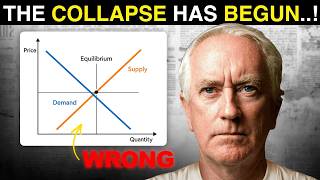
Preview:Steve Keen argues that mainstream supply-and-demand economics is a misleading model of how firms actually set prices and how markets work. He says real-world firms mostly face constant or falling marginal costs, compete through product differentiation rather than price, and that conventional demand-curve theory is behaviorally false.
Preview:Steve Keen argues that a shutdown of the Strait of Hormuz would expose how dependent modern economies are on energy, fertilizer, and other physical inputs, potentially triggering a global food shock and acting as a brutal warning about climate and biosphere limits.
Preview:A heated discussion argues that China’s growth model is real but misunderstood: Steve Keen defends China’s high investment, state-directed banking, policy experimentation, and recent reforms, while rejecting claims that China is simply a centrally planned failure. The counterparty presses the sustainability case, focusing on capital flight, property-rights risk, demographics, fiscal strain, and alleged lack of innovation.
Preview:Steve Keen argues that a war disrupting the Strait of Hormuz would be far more dangerous through fertilizer supply shocks than through oil alone, potentially triggering food shortages and famines in vulnerable import-dependent countries this year.
Preview:Steve Keen argues that a Strait of Hormuz blockade would be a global energy shock first and an oil-price story second. He contrasts his post-Keynesian view—that output is tightly constrained by energy—with neoclassical models that treat energy as a minor input and therefore understate the GDP damage from an oil and LNG disruption.
Preview:Steve Keen argues the AI boom is a classic speculative investment cycle that is likely to end in a severe bust within roughly 24 months, with major knock-on effects for tech valuations, employment, and aggregate demand.
Preview:Steve Keen argues that a major disruption in the Strait of Hormuz would not be a minor, substitutable shock but a direct hit to real output, because energy is a binding input rather than something labor or capital can replace.
Preview:Steve Keen argues that the U.S. presidency functions like an elected monarchy: too much executive power, too little ability to remove a bad president, and a two-party system that blocks real democratic choice. He says the issue is not just Trump but the constitutional design itself.
Preview:Steve Keen argues the Iran/Oil shock is both a geopolitical crisis and a possible market-integrity scandal, claiming a large oil trade 15 minutes before Trump’s announcement looks like potential insider-style front-running. He then uses the episode to attack mainstream economics, arguing energy losses transmit almost one-for-one into GDP and that a prolonged oil disruption would be a major global economic shock.
Preview:The guest argues the war is a high-stakes, fragile escalation driven by Israel/U.S. attempts to break Iran, with immediate risks centered on Gulf energy infrastructure, the Strait of Hormuz, and nuclear brinkmanship. He also uses the interview to extend that fragility thesis into a broader macro warning: energy, food, and industrial supply chains are far more vulnerable than markets assume, while AI creates a separate boom-bust and labor-displacement risk.
Preview:Steve Keen argues that escalating conflict around Iran is exposing the fragility of the global production system, especially energy, fertilizers, and helium, and that this can accelerate the long-run decline of the US dollar's dominance and Pax Americana.
Preview:Steve Keen argues Bitcoin is becoming strategically irrelevant in a world of war, energy shocks, and rationing, because it does not solve real payment-system needs and its energy-intensive design makes it vulnerable if energy becomes scarce. He uses the Iran conflict and damaged Gulf energy infrastructure to argue the global economy is constrained by physical energy, not monetary narratives.
Preview:Steve Keen argues the Trump/Israel-Iran war gamble is likely to trigger global recession, higher inflation, falling stocks, and a flight to gold, while also accelerating political backlash inside the U.S. He grounds the call in his long-standing Minsky/debt-crisis framework and warns the conflict could escalate further if Israeli defenses fail.
Preview:Steve Keen argues Trump’s Iran war is driven by narcissism, not strategy, and says it accelerates a broader U.S. regime break: dollar dominance fading, recession risk rising, and political legitimacy eroding.
Preview:Steve Keen argues the Iran war is an oil shock first and a geopolitical shock second, with potential for stagflation, higher pump prices, and pressure on Europe and other oil-import-dependent economies. He says private debt is still the bigger underlying fragility than government debt, while also warning that the nuclear risk makes all other market calls secondary.
Preview:Steve Keen argues the Iran war is a reckless, unnecessary escalation that will likely weaken U.S. imperial legitimacy, encourage nuclear proliferation, destabilize the Middle East, and expose how fragile the global economy really is. He frames the conflict as driven more by U.S./Israeli religious and political extremism than by a genuine security need, while warning that miscalculation could trigger broader regional war or even Israeli nuclear use.
Preview:Steve Keen argues that the Iran conflict could trigger a severe oil shock, driving war-led inflation, supply shortages, and stagflation, especially in Europe. He also says the bigger underlying risk is still excessive private debt, which makes the economy fragile even if the immediate crisis is geopolitical.
Preview:Steve Keen argues that Tesla, Palantir, AI, and Bitcoin are all examples of markets mispricing popular narratives rather than valuing durable fundamentals. He says growth stocks are often overvalued, mean-revert, and underperform the boring cheap stocks that pay dividends; he also says Bitcoin is a pure speculative vehicle that cannot replace fiat money and is heading toward collapse.
Preview:Steve Keen argues that the world is entering a more dangerous geopolitical and economic regime because China has built industrial, trade, and strategic leverage that the U.S. can no longer easily counter. He ties that shift to military risk, trade imbalances, public investment, education, and America’s long decline in manufacturing and social capacity.
Preview:Steve Keen argues that the post-Bretton Woods dollar-based world order is breaking down and that a new international settlement system is needed. He says the current setup overvalues the reserve-currency country’s exchange rate, damages manufacturing, empowers finance, and eventually gets replaced by a rising rival — now China — while Trump’s disruptions may accelerate the transition.
Preview:Steve Keen argues Elon Musk’s apocalyptic view of U.S. debt is built on bad textbook accounting, not real-world monetary mechanics. Keen uses his Revel model to show that if you account for bank-created money and central-bank reserves properly, government deficits raise GDP and money supply rather than mechanically snowballing into bankruptcy.
Preview:Steve Keen argues that the usual “government will go bankrupt” story about U.S. debt is wrong because it ignores double-entry accounting and the fact that a currency-issuing government cannot be forced into insolvency the way a household can. He says the real issue is not whether the Treasury can “run out of money,” but how bonds, reserves, and deficit spending move financial equity across sectors, with the key implication that government deficits support private-sector net financial assets and should not be framed as crowding out.
Preview:Steve Keen argues that Donald Trump is not the root cause of the current global monetary disorder but the latest symptom of a much older flaw: the post-Bretton Woods system that made the US dollar the world’s reserve currency. His core thesis is that using a national currency for international trade overvalues the currency, weakens manufacturing, and eventually destabilizes the empire that issued it; he says Keynes’s alternative clearing-union idea would have been more durable and should be revived now.
Preview:Steve Keen argues mainstream economists are again blind to crisis risk because they force a dynamic, debt-driven capitalist economy into an equilibrium framework. He uses Irving Fisher’s role before and after the 1929 crash as the core historical example, then links that mistake to the Great Depression and the 2008 global financial crisis.
Preview:Steve Keen argues the AI boom is a classic overinvestment bubble that will end in bankruptcies, a recession, and a painful adjustment in income distribution. He thinks AI and robotics could eventually raise productivity dramatically, but only if society solves the problem that machines may eliminate both workers’ jobs and consumers’ incomes.
Preview:Steve Keen argues that mainstream fears about government deficits confuse accounting with economics. Using double-entry bookkeeping, he claims government spending above taxation creates money and adds financial assets to the private sector, while deficit reduction can worsen speculation, bubbles, and underinvestment in public goods.
Preview:Steve Keen argues that mainstream neoclassical economics is built on a false equilibrium assumption and that this helps explain repeated forecasting failures, especially around the global financial crisis. He contrasts equilibrium-based models with nonlinear, far-from-equilibrium dynamics from physics and complex systems, then promotes his own stock-flow/system-dynamics approach as a better framework for macroeconomics.
Preview:Steve Keen argues that the U.S. debt problem is really an accounting problem: in a credit-money system, the non-bank private sector is structurally pushed into negative financial equity unless the government runs deficits. He says government deficits are not a bug but a necessary feature of fiat money creation, while bond issuance is a separate operation used to manage the Treasury's central bank balance, not to finance spending.
Preview:Steve Keen argues that neoliberalism has been a failed economic ideology: it slowed growth, shifted income away from workers toward finance, inflated asset prices, and left many people unable to retire or buy homes. He contrasts this with a more Keynesian/Minskyan view in which private debt drives booms and busts, government spending can stabilize the cycle, and public provision is needed for long-term infrastructure and essential services.
Preview:Steve Keen argues that mainstream economics is built on a fundamentally wrong neoclassical framework and that this explains why economists keep missing crises, misdescribing markets, and ignoring banking reality. His core example is that banks create deposits when they lend, while standard textbooks still teach intermediaries-and-multipliers; he also argues the usual rising-marginal-cost / downward-sloping demand story is empirically false for most firms and that economics resists correction because it is tied to ideological purposes rather than open-ended science.
Preview:Steve Keen uses the first lecture of his 7-week Rebel Economist challenge to argue that mainstream neoclassical economics is built on a false equilibrium framework, ignores major historical failures like the Great Depression and the global financial crisis, and badly misunderstands money, debt, macro dynamics, and climate/energy constraints. He uses historical analogies, textbook critiques, and his own modeling work to argue for a non-equilibrium, systems-based alternative centered on credit, debt, and energy.
Preview:Steve Keen argues that mainstream economics has repeatedly been wrong about money, banking, and debt because it ignores basic accounting. His core example is the Global Financial Crisis: he says economists like Ben Bernanke treated bank lending as mere intermediation, missed the buildup in private debt, and therefore missed the crash.
Preview:Steve Keen argues that mainstream economics is built on false assumptions about equilibrium, prices, money, and government, and that those errors turn economics into ideology when filtered through politics. He and Peter McCormack debate money creation, inflation, house prices, gold, Bitcoin, public goods, and the role of the state, with Keen defending post-Keynesian views, endogenous money, and the need for some state provision.
Preview:Steve Keen argues mainstream economics is built on false assumptions about money, banks, debt, and prices, and that private debt is the real systemic risk. He also says the euro was a mistake, QE inflated assets, and climate change is an existential threat that economists have vastly understated.
Preview:Kai Hoffen interviews Professor Steve Keen about Ray Dalio’s warning of an “economic heart attack” in three years. Keen argues Dalio is wrong on the mechanism: the real issue is not government borrowing crowding out funds, but the fact that banks create money through lending and governments create money through deficit spending. He says the mainstream and Dalio both misunderstand the monetary system, while Trump’s tariffs and pressure on the Fed are chaotic but partly aimed at the right symptoms.
Preview:Professor Steve Keen argues the global economy remains in the long aftermath of 2008, with private debt still at ~150% of GDP but not on a trajectory for imminent internal collapse. He sees the next major crisis coming not from financial dynamics but from climate change triggering a "climate Minsky moment" — insurance collapse, mortgage market failure, and ultimately private financial system breakdown. He is deeply critical of neoclassical economics, advocates a "modern debt jubilee," dismisses gold as a barbarous relic used only in societal collapse, and views Bitcoin as the greatest speculative bubble in history whose energy consumption will be its undoing.
Preview:Professor Steve Keen argues that the US government's obsession with cutting the budget deficit — spearheaded by Elon Musk and the Trump administration — is fundamentally misguided and will cripple the economy. Using double-entry bookkeeping logic, he explains that government deficits actually create fiat money and increase private-sector net worth, while surpluses destroy money. He warns that deficit-slashing could cause a recession "for no good reason" and that the real debt problem is private debt, not government debt. He proposes a "modern debt jubilee" as a theoretical solution to private over-indebtedness but concedes it will never happen.
Preview:Steve Keen argues that private debt, not government debt, is the real economic danger — private entities can go bankrupt while a currency-sovereign government cannot. He contends the US government's deficit spending creates money (not "borrowing"), that the bond market merely swaps non-interest-bearing reserves for interest-bearing tradable bonds, and that Trump's aggressive spending cuts risk a deflationary shock. On tariffs, Keen breaks from conventional economics: he argues tariffs historically drove industrialization (US, Korea, Japan) by forcing domestic investment, though Trump misunderstands who pays them. He sees the US dollar's reserve status as structurally overvaluing the currency and undermining manufacturing — you cannot have both a strong dollar and a strong manufacturing sector. Near term, he expects economic stuttering from fiscal contraction.
Preview:Steve Keen argues that tariffs are not well understood by mainstream economics, but that the immediate effect is mostly to raise costs for U.S. importers and then partially to consumers, not for foreign exporters to “pay” the tariff. He is more concerned about tariffs as a lever for reshoring production and about whether they worsen supply-chain costs than about simple inflation pass-through. Broader than tariffs, his central thesis is that the real crisis is private debt, not public debt or inflation alone: bank-created credit, asset inflation, and inequality have distorted the economy, while the U.S. has been deindustrialized and weakened by its reserve-currency role.
Others tracked across the same asset focus or market thesis.
Unlock every transcript this speaker appears in, compare them with your other followed voices, and ask the agent for the bull, bear, and consensus read in one workspace.
Type a question. Create a free agent to send it and keep the answer linked to this speaker.
Your question is preserved across sign-in.
Free. No card. Takes about a minute.