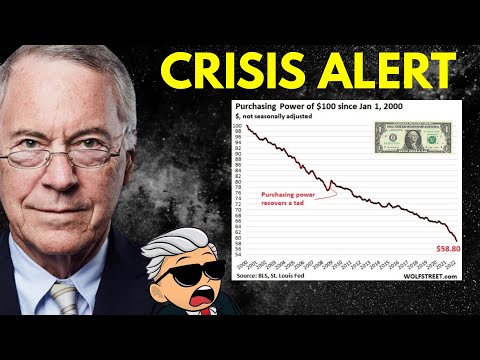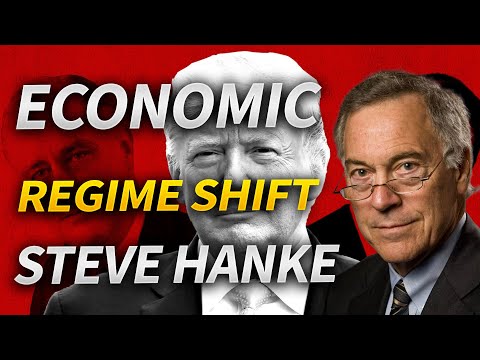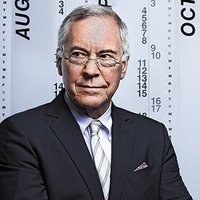
Hanke’s recurring economic worldview is broadly anti-inflationary, anti-sanctions, and skeptical of state intervention.
📈 See how Steve Hanke's thesis changed over time →Preview how this speaker shows up across market transcripts. Unlock the full archive, AI chat, and the version personalized to your watchlist, followed channels, and favorite speakers.
Steve Hanke is a Johns Hopkins applied economist and prominent public commentator on inflation, monetary stability, fiscal accounting, and crises. In the supplied material he appears as a hard-edged, data-driven critic of government balance sheets and central-bank policy, comfortable making blunt claims and defending them through accounting-style reasoning. He also repeatedly comments on geopolitics and commodities, especially how Middle East conflict, sanctions, and oil disruptions affect prices and the global economy. The external items and X posts show he uses his own platform to amplify these views and to comment on current events in a strongly opinionated way. He also has a recurring public presence on Bitcoin, where he is skeptical.
Hanke’s recurring economic worldview is broadly anti-inflationary, anti-sanctions, and skeptical of state intervention. He emphasizes hard constraints: balance sheets, money supply, commodity flows, and physical supply disruptions. He tends to frame inflation and market stress as consequences of monetary excess, fiscal imbalance, and policy error rather than as temporary noise. He is especially attentive to money growth, government solvency, and how war or sanctions can destabilize prices and global trade. Across the material, he portrays sanctions as ineffective, views oil and commodity markets through a supply-disruption lens, and argues that governments can become insolvent when liabilities overwhelm assets. His style suggests a preference for accounting-based diagnosis over political spin, with a persistent concern that official institutions understate structural fiscal and inflation risks.
Every analyzed appearance we have for this speaker, newest first. Open any transcript preview to read the underlying transcript.
Preview:Steve Hanke argues the oil market is tightening again because the Iran conflict has disrupted both the Strait of Hormuz and Red Sea flows, cutting inventories and steepening backwardation. He also says U.S. inflation remains the bigger macro issue because broad money growth is still too fast, while gold, the yen, and the AI trade all reflect distorted market behavior and fatigue.
Preview:Steve Hanke argues that oil and refined-product markets are being squeezed by war-driven supply disruptions, low inventories, and backwardation, and that the price shock may still be ahead rather than fully priced in. He remains bullish on gold, sees central-bank buying as the key structural driver, and thinks the broader deglobalization/commodity-super-cycle backdrop favors commodities, copper, tungsten, and fuel-sensitive producers over time.
Preview:Steve Hanke argues the market is sitting in a "massive bubble" driven by two forces at once: very high valuations and earnings running far above trend. He ties the setup to accelerating money-supply growth, which he says first lifts asset prices, then activity, then inflation and yields. He also flags the Japanese yen/carry trade as a secondary risk factor, while staying constructive on oil and gold in the near term.
Preview:Professor Steve Hanke maintains a structurally bullish gold thesis ($6,000 target) despite the recent pullback, which he attributes to dollar strength and rotation into tech. He argues M2 and Divisia M4 money supply are accelerating — Divisia M4 growing at ~6.7% YoY, above his 6% "golden growth rate" — meaning the "inflation genie is out of the bottle." He sees a commodity super cycle beginning, is outright bearish on bonds, and expects longer-end yields to keep rising. On the Fed, he's cautiously optimistic about Chairman Warsh potentially embracing quantity-theory frameworks but is waiting for clearer signals. He also discussed his forthcoming book advocating currency boards as a replacement for discretionary central banking in developing countries.
Preview:Steve Hanke argues the market and economy are being driven less by fundamentals than by “big players,” political announcements, and noise trading. He says the Iran/U.S. conflict has lifted oil’s fair value well above the current price, inflation remains too hot for cuts, and broader inequality reflects Fed-driven money growth that has inflated asset prices and favored the wealthy.
Preview:Professor Steve Hanke argues the US is in a massive bubble with a mania that is spilling into physical commodity markets, but he sees the recent oil sell-off as a temporary overshoot driven by "big player" behavior (Trump) rather than fundamentals. He expects crude to return to an $85–$90 baseline. The conversation then shifts to strategic petroleum reserve depletion and the acute vulnerability posed by Iran potentially closing the Strait of Hormuz — a scenario Hanke says could cause shortages, though he does not expect a return to 1970s-style rationing in the US given the political disaster that would be.
Preview:Steve Hanke argues that inflation is already entrenched, the Fed will likely be pushed toward tighter policy, and the bigger monetary driver is commercial-bank credit creation rather than the policy rate alone. He also argues the Iran conflict has badly worsened U.S. strategic standing and raised geopolitical and oil risks.
Preview:Steve Hanke argues the Iran war has already pushed Gulf states into pragmatic hedging: Qatar, the UAE, Oman, and Saudi Arabia are all reportedly engaging Iran to reduce risk, protect trade, and preserve energy/shipping flows. He sees this as evidence the US looks unreliable, while the immediate operational bottleneck is the Strait of Hormuz and the large number of ships and seafarers still stuck in the Persian Gulf.
Preview:Steve Hanke argues that inflation is primarily a monetary phenomenon, not a story about oil, tariffs, or supply shocks. He says recent U.S. inflation is being driven by accelerating money supply growth, and that the Fed is still underestimating the lagged effects of prior monetary expansion. He also sees gold in a secular bull market toward $6,000 an ounce and rejects de-dollarization as a major thesis, saying the dollar remains the dominant international currency.
Preview:Steve Hanke argues that any Iran–U.S. peace deal would be a geopolitical defeat for the U.S., not a clean resolution. His core point is that the agreement, as described in leaks and Iranian commentary, appears vague, delayed, and full of unresolved spoilers—especially Israel, sanctions, shipping access in the Strait of Hormuz, and the uncertain U.S. military drawdown.
Preview:Professor Steve Hanke argues the market is being driven by three linked forces: geopolitical disruption in the Strait of Hormuz, a still-loose monetary backdrop, and a broader commodity super-cycle. He is bearish on the idea that the recent oil shock is over, bullish on commodities broadly, and still constructive on gold over the secular horizon even though it has recently consolidated.
Preview:Prof. Steve Hanke argues that Israel is the main spoiler in the Iran/U.S./Israel triangle and is trying to pull the U.S. back into more direct war with Iran. He says Trump is starting to realize the Iran episode is a failure, with the main consequences now shifting from military to economic damage: weaker markets, higher oil, and broader commodity inflation.
Preview:Steve Hanke argues that the market is in a 'danger zone' because the US 10-year yield above roughly 4.5% feeds higher borrowing costs, hurts housing and credit, and exposes the US deficit problem. He also says the Iran/Hormuz situation is likely to keep commodity prices elevated, while Canada remains tightly tied to the US and can only improve marginally via liberalization and trade diversification.
Preview:Steve Hanke argues the dollar remains dominant and U.S. capital markets are still overwhelmingly attractive, but he thinks the margin is where the risk lives: small erosions in confidence, policy consistency, and perceived openness can matter for investors even if they do not amount to true de-dollarization.
Preview:Steve Hanke argues the U.S. is weakening itself through tariffs, sanctions, industrial policy, and militarism while China is gaining leverage through control of rare earths, commodities stockpiles, and cleaner-energy supply chains. He is bullish on gold and commodities, bearish on bonds, and thinks inflation will keep rising as money supply growth accelerates.
Preview:Steve Hanke argues the US stock market is in bubble territory, inflation will reaccelerate because money supply growth is running hot, China is the main strategic winner, and gold can still reach $6,000-$7,000 as commodities and rearmament drive a broader super-cycle.
Preview:Steve Hanke argues the Iran war is a strategic win for China and Russia, a strategic loss for the U.S., and a catalyst for higher defense-related commodity demand. He sees oil spikes, a commodities supercycle, and gold eventually reaching $6,000-$7,000 despite temporary pressure from higher bond yields.
Preview:Steve Hanke argues markets are complacent because they are misreading inflation, bank lending, and debt dynamics; he expects stronger bank credit growth to feed inflation, favors hard assets over bonds, and sees a continuing bull case for gold, silver, and certain critical materials, while dismissing the AI-deflation narrative as overhyped.
Preview:Steve Hanke argues that inflation is set to stay sticky in the U.S. because money supply growth is accelerating again, while China is comparatively better positioned because it has inventories and is already in a weaker inflation/deflation environment. He ties the biggest near-term market risk to the Iran war and Strait of Hormuz disruption, saying markets are complacent, oil could gap higher, and commodities broadly may be entering a new super cycle.
Preview:An interview-style episode on Wall Street Bullion with Steve Hanke argues that Middle East disruptions are pushing oil, commodities, and gold higher, while silver sits inside a broader hard-asset supercycle. The speaker is explicitly bullish on gold, silver, and industrial commodities, and bearish on tech-heavy portfolio exposure and on the policy competence of the current U.S. administration.
Preview:Steve Hanke argues the U.S. is already economically and fiscally insolvent, inflation is reaccelerating, and the Iran war is both financially reckless and likely to worsen affordability. The interview centers on his monetary view that inflation is driven by money supply growth, not oil, and on his claim that deficits are deferred taxes imposed on future generations.
Preview:Steve Hanke argues the U.S. is fiscally insolvent, the Iran war is already damaging bonds, oil, and global growth, and Iran may be winning by controlling the Strait of Hormuz and forcing the West into higher costs. He stays bullish on gold structurally, while warning that war, deficits, and sanctions are worsening the macro backdrop.
Preview:Steve Hanke argues the Iran/Hormuz shock is serious but less systemically dangerous for the U.S. than the 1979 oil crisis because the U.S. is less oil-dependent now, while the bigger macro risk is an already-bubbly equity market and an accelerating money supply that he thinks will keep inflation elevated.
Preview:Steve Hanke argues the Iran/Gulf crisis is mostly a warning shot so far, not a market-disrupting event, because he thinks Iran is bluffing, the U.S. is constrained by Iran’s defenses, and oil would only spike hard if Hormuz were fully closed. He is similarly skeptical of a reported Russia-dollar memo, remains bullish on the dollar’s reserve status, expects U.S. inflation to drift back up as M2 accelerates, and says upcoming Fed easing would be driven more by labor-market weakness than inflation progress.
Preview:The video is a gold-and-silver themed interview with Steve Hanke that mixes a promotional silver giveaway and a market discussion. Hanke argues the recent precious-metals pullback is mostly technical consolidation after a big run, says the deeper concern is growing state intervention, rejects the AI boom as overhyped, and recommends portfolio rebalancing plus a modest gold allocation.
Preview:The speaker argues that gold and silver are still in a strong bull market and that recent volatility is a buyable consolidation, not a top. He urges viewers to buy gold now for lower downside risk, treat silver as the more volatile higher-beta trade, and expects another big rally led by Asian buying and broader remonetization of hard assets.
Preview:Steve Hanke, professor of applied economics at Johns Hopkins, reaffirms his gold bull-market peak target of $6,000–$7,000/oz based on a GDP-per-capita ratio model analogous to 1979–80. He views the recent correction as healthy consolidation that washed out weak hands. On the US economy, he dismisses Trump administration hype of 5–6% growth, anchoring instead to ~2.5% potential with Goldman's ~2.8% as a reasonable upper bound. He highlights a K-shaped economy where top-20% earners drive consumption while most Americans suffer from affordability and inflation pressures. He is skeptical of AI/productivity miracle narratives and warns that resurgent M2 growth means inflation will not return to target. On geopolitics, he sees US tariff threats accelerating a pivot by allies toward China and India.
Preview:The video is an interview-style macro discussion with Mark Skousen and Steve Hanke about a possible ‘financial crisis of 2026.’ Both see slow growth with sticky inflation, but they differ on how much current policy and geopolitics matter. They are broadly constructive on gold and silver, while Hanke is even more bullish on uranium and some industrial commodities tied to AI and infrastructure.
Preview:Steve Hanke argues the Trump administration is using Greenland, Canada, tariffs, and legal pressure on the Fed as coercive tools that undermine allies, international cooperation, and Fed independence. He says the more immediate market risk is easier money and higher inflation, which supports commodities and keeps the stock bubble alive, while oil remains his main bearish exception unless Middle East conflict disrupts supply.
Preview:Steve Hanke argues the Fed has not fully beaten inflation and is now pivoting back toward easier policy, which he thinks risks re-igniting the inflation problem. He also says U.S. equities look bubble-like, the dollar is still strong but likely softer, gold and other precious metals remain in a secular bull market, and Venezuela and Iran show how extreme inflation destabilizes economies. He closes with a simple framework: the money supply drives inflation, asset prices, and activity, so investors should watch policy through that lens.
Preview:Steve Hanke argues the Venezuela operation was a highly planned, internally enabled military coup, but says the real issue is what happens next: regime-building, not the arrest itself. He is far more focused on U.S. domestic inflation, arguing monetary easing, balance-sheet expansion, and deregulation will keep inflation elevated and make affordability a political problem into the 2026 midterms.
Preview:Steve Hanke argues that 2026 will likely bring higher inflation, higher unemployment, and a worse affordability picture in the U.S., with politics and markets shaped by that combination. He says the Fed’s recent policy shifts, including reserve-management Treasury purchases, rate cuts, and looser bank constraints, point to faster money-supply growth and therefore renewed inflation pressure. He extends that framework to gold and silver, a weaker dollar, Japan’s policy mix, China’s weak nominal growth, and U.S. sanctions/blockades on Venezuela and Cuba.
Preview:Steve Hanke argues that U.S. inflation is not defeated and could re-accelerate because several forces are set to loosen financial conditions: a near-certain Fed cut, the end of QT, the coming April removal of a bank liquidity constraint, and heavy Treasury bill issuance that he says is being monetized through money-market funds. He also says the Japanese yen carry trade is a key bubble risk: if the yen strengthens, carry positions could unwind, money could come out of equities, and that could help pop an already-bubbled U.S. stock market.
Preview:Steve Hanke argues inflation is likely to re-accelerate because money growth is picking up, the Fed is about to stop QT, bank regulation may free up lending, and deficit financing is increasingly being monetized. He sees today’s market as already in a bubble, thinks equities could keep inflating if policy loosens further, and recommends investors focus on rebalancing and inflation hedges like gold rather than trying to time a full exit.
Preview:Professor Steve Hanke warns that money supply growth is accelerating (~4.5% YoY), and with the Fed ending quantitative tightening in December plus the removal of the supplementary leverage ratio (unlocking ~$2.6T in bank lending capacity), there is a "yellow light flashing" risk of reigniting asset bubbles and inflation. He notes his bubble detector is at an all-time high, sees gold in a secular bull market with a $6,000/oz target, and is "on the fence" about recession odds — labor weakening argues for slowdown, but money supply acceleration could keep the economy humming. He is deeply critical of the Fed's data-dependent, neo-Keynesian approach that ignores the money supply entirely.
Preview:Economist Steve Hanke argues that NYC mayor-elect Zoran Mandani's proposals — $30 minimum wage, free buses, rent freezes, city-run grocery stores, and massive public housing construction — are fiscally impossible and would accelerate New York's decline. Hanke frames Mandani as a socialist "fast talker" who will be "mugged by reality" when the budget math catches up. He traces the underlying affordability crisis to Fed money-supply expansion post-COVID, which enriched asset owners while eroding real wages for lower-income households.
Preview:Steve Hanke argues that modern central banking has abandoned the quantity theory of money, which in his view explains inflation, asset booms, and rising inequality better than neoclassical models. In this interview with Jimmy Connor, he uses the post-COVID money-supply surge to support the claim that inflation was predictable and says the Fed is not truly independent in practice.
Preview:Steve Hanke argues that the macro setup is shifting toward easier money, which he thinks would re-accelerate inflation and support gold. He sees gold consolidating around $4,000 after a move to $4,400, still in a secular bull that could ultimately peak near $6,000, while warning that the equity market is in a bubble by standard valuation measures. He also thinks the long bond bull market has ended, deficits are large, oil is weak, and the shutdown was a mild negative but not the main driver.
Preview:Professor Steve Hanke argues the US dollar's dominance is strengthening (not de-dollarizing), gold has a secular bull market targeting $6,000/oz, and Argentina should dollarize rather than receive US bailouts. He critiques Trump's tariffs as creating a "bureaucratic mess" with massive revenue leakage, warns the Fed may overdo monetary loosening and reignite inflation, and predicts the Supreme Court logically should strike down tariffs under the IEEPA — creating months of uncertainty, all bullish for gold.
Preview:Steve Hanke argues that Argentina should dollarize or adopt a hard currency-board-style regime, saying the peso and central bank are the country’s main weakness and that a clean conversion at the right exchange rate would stop capital flight, lower inflation, and trigger a confidence-led boom. He also says the Trump administration is discussing a broader pro-dollar strategy, stablecoins reinforce Treasury demand, and gold remains in a strong secular uptrend with $4,000 acting as a consolidation zone and about $6,000 as a longer-run peak target.
Preview:David Lin interviews economist Steve Hanke about the market selloff, tech bubble risk, gold near $4,000, repo stress, the end of QT, Argentina’s peso problem, dollarization, tariffs, and China’s leverage. Hanke’s core view is that equities—especially tech—are in bubble territory, gold is consolidating rather than topping, QT ending matters more than repo noise for money growth, and dollarization would solve recurring currency crises like Argentina’s. He also argues China still has major strategic leverage because it controls critical materials.
Preview:Professor Steve Hanke of Johns Hopkins discusses his advisory role with the Trump administration on a pro-dollarization strategy to counter de-dollarization by China and BRICS. He outlines three mechanisms: official dollarization (replacing a local currency with USD), currency boards (local currency 100% backed by USD), and dollar-based stablecoins under the GENIUS Act. Argentina is the prime candidate, though IMF opposition and feasibility concerns remain hurdles. Hanke gives a $6,000 gold price target based on 1980-era disposable-income metrics, noting consolidation around $4,000 and a 2:1 call/put ratio betting above that level.
Preview:Professor Steve Hanke returns to David Lin's show to defend his $6,000 gold call (based on secular bull peaks hitting ~10% of US disposable personal income per capita), assess the US equity bubble via his "Dr. X" bubble detector, and argue that Trump's 100% tariff on China is self-defeating theater. He warns China could "shut down" the West in 6-9 months via critical mineral export bans, dismisses tariff-driven inflation fears because money supply remains subdued, and notes emerging cracks in regional banks. Silver gets a brief mention via an anecdote about an old friend's hoard. Hanke sees the Fed cutting as priced by the CME.
Preview:Professor Steve Hanke presents a monetarist case that the US economy is slowing beneath the surface, despite strong headline GDP. He argues that gross output (GO) grew at just 1.2% vs GDP's 3.8%, and final sales to domestic purchasers are decelerating — both consistent with a tight money supply since April 2022. His core call: a recession is coming, and gold is in a secular bull market that will peak around $6,000/oz, above Goldman's $5,000 scenario.
Preview:Steve Hanke argues the gold secular bull market will continue, peaking around $6,000/oz based on US disposable per capita income growth — not apocalyptic scenarios. He critiques central banks' obsession with interest rates, urging focus on money supply growth (~6% "golden growth rate"). Hanke sees the Fed's 25bp cut as largely symbolic; mortgage rates follow the 10-year, not Fed funds. He expects further dollar weakening (EUR/USD fair value 1.20–1.40), an economic slowdown baked in from past money supply contraction, and an overvalued stock market in a bubble. He advocates ending quantitative tightening as the real loosening mechanism.
Preview:Economist Steve Hanke argues the US dollar's weaponization via sanctions and tariffs is accelerating de-dollarization, benefiting gold. He sees a one-two punch of slow money supply growth (~4.7% YoY) plus Smoot-Hawley-level tariffs pushing the US toward recession, with equity markets in bubble territory. He frames gold as the natural beneficiary, notes the trade deficit is misunderstood by Trump, and warns the current tariff regime mirrors 1930 in its effective rate.
Preview:Steve Hanke argues that central banks, markets, and policymakers are all focused on the wrong thing — interest rates — when they should be watching the money supply (M2). He walks through three historical episodes (Japan's lost decades, post-GFC US, and post-COVID US) to demonstrate that M2 growth rate, not the Fed funds rate, explains inflation outcomes. Hanke warns the US economy is slowing and will likely enter recession within 12 months, aggravated by Trump's tariffs which he compares to Smoot-Hawley. On gold, he sees the current rally as a knee-jerk reaction to Powell's Jackson Hole speech, but longer-term, eventual loosening will reignite inflation and keep the gold bull market roaring.
Preview:Steve Hanke argues that U.S. inflation is still headed lower because money-supply growth is below the pace he считает consistent with a 2% inflation target. He says tariffs are not fundamentally inflationary; they are a tax and a drag on growth that can cause relative price increases, but not sustained aggregate inflation unless the money supply is accommodated. He also argues the economy is weakening toward recession and financial markets are in bubble territory.
Preview:Steve Hanke argues sanctions and tariffs are self-defeating, the dollar is still structurally strong but more vulnerable because it has been weaponized, and the bigger near-term risk is recession driven by slow money growth and regime uncertainty. He is bullish gold, skeptical of Bitcoin in this context, and sees China’s deflationary slowdown as the key cap on industrial metals.
Preview:Steve Hanke argues the US economy is at a tipping point toward recession, driven by near-zero money supply growth over the last ~3 years. He dismantles the textbook money-multiplier model, insisting commercial banks create money "out of thin air" and that monetary policy is about money supply growth, not interest rates. He calls Bitcoin a speculative frenzy with zero fundamental value, says we're in an asset bubble per his "bubble detector," and advocates skepticism toward all government economic data. On policy, he wants the Fed to end QT and remove the supplementary liquidity reserve requirement to boost money supply growth toward his 6.3% "golden growth rate."
Preview:Steve Hanke argues the U.S. is entering a debt-and-confidence trap: persistent deficit spending, rising interest costs, and regime uncertainty could push rates higher and pressure bonds, housing, and stocks. His preferred defensive response is to shorten bond duration, avoid speculative assets, and own gold, which he says he has been bullish on throughout the current bull market.
Preview:Steve Hanke argues the U.S. is in a speculative, overvalued asset bubble driven by earlier money-supply growth and reinforced by a still-active frenzy in stocks, crypto, gold, and other hard assets. He says tariffs are a bad revenue tool and that Fed policy should focus on money supply and balance-sheet policy, not the Fed funds rate.
Preview:Economist Steve Hanke argues that inflation remains on a downward trajectory despite June's CPI uptick, because inflation is always a monetary phenomenon and money supply growth has been anemic (~4.5% vs. his 6.3% "golden growth rate"). He assigns both Trump and Fed Chair Powell an "F" grade for focusing on interest rates instead of money supply. Tariffs may cause one-time price-level blips but won't reignite sustained inflation. Hanke advocates stopping quantitative tightening and adopting the quantity theory of money, and promotes his new book "Making Money Work" co-authored with Matt Sekerke, which argues for neutral monetary policy and restoring money to the center of macroeconomic thinking.
Preview:Professor Steve Hanke argues the US economy faces a "one-two punch": a multi-year money supply slowdown (M2 growing only ~4% vs. his 6% golden growth rate) layered with Trump-era "regime uncertainty" — the first such regime change since FDR's New Deal. He sees a recession as "baked in the cake" by year-end, with the stock market in bubble territory comparable to 2001. Companies have stopped giving earnings guidance, M&A has dried up, and new graduates can't find jobs — all blamed on uncertainty. China is simultaneously in deflation. Hanke criticizes the Fed for being too hawkish and ignoring money supply in its models, and warns that Trump's ability to actually change the system is limited by Congressional resistance — "a big gap between rhetoric and reality."
Preview:Steve Hanke argues the Iran-Israel conflict is being driven by Netanyahu and the Israeli lobby's influence over Trump, that sanctions are a "fool's game" that never work, and that the US could stop Middle East wars immediately by cutting off funding. On markets, he warns the US stock market is in a bubble, predicts a recession in H2 2025 driven by money supply contraction and Trump-created regime uncertainty, and dismisses tariff-driven inflation fears — insisting only money supply matters for inflation. He advises following Buffett's lead (cash + patience) and holding some gold.
Preview:Steve Hanke argues the U.S. is entering a high recession-risk period because monetary growth has been too weak since 2022 and Trump-era tariff/regime uncertainty is adding another drag. He says stocks are still in bubble territory, the Fed is looking at the wrong lever if it focuses only on rates, and investors should watch gold, the 10-year yield, the dollar/euro rate, and money supply growth.
Preview:Professor Steve Hanke argues the market is sleepwalking through Trump-era regime uncertainty, comparing it to the 1930s New Deal period when investment froze. He sees M2 money supply data pointing to economic slowdown and disinflation, with a recession probability much higher than consensus. On gold, he is structurally bullish due to central bank diversification away from a weaponized dollar, but notes falling inflation is actually a negative for gold. On oil, he is bearish because non-OPEC supply can meet all incremental demand. He repeatedly plugs his new book Making Money Work and views the quantity theory of money as the essential analytical framework.
Preview:Steve Hanke argues that inflation is still easing because money growth is weak, but Treasury yields are being pushed up by tariff-driven regime uncertainty and fiscal risk. He expects the economy to slow into a late-year recession, with the Fed cutting only after the labor market weakens, while equities still look too optimistic on earnings.
Preview:Steve Hanke argues the U.S. is heading into a recession because broad money has contracted since 2022 and is still growing too slowly to support 2% inflation. He extends that framework to say Trump-era tariff and policy upheaval creates regime uncertainty, which could deepen the slowdown and pressure equities, while gold benefits from sanctions, dollar devaluation, and rising lawlessness in the global system.
Preview:Steve Hanke argues the US is increasingly acting like an emerging market because policy volatility, tariffs, and legal/institutional uncertainty are making stocks and bonds fall together. He sees gold as the clearest beneficiary of that trust breakdown, while blaming the Fed for ignoring money-supply dynamics and calling the trade deficit a domestic accounting problem rather than foreign cheating.
Preview:Steve Hanke predicts a >90% recession probability in 2025, driven by a "one-two punch" of money supply contraction (since mid-2022) and Trump's tariff-driven "regime uncertainty." He sees S&P 500 earnings growth falling to zero or negative (vs. 10% consensus), the stock market decline as just beginning, and inflation continuing to fall — potentially hitting 2% or below — because tariffs only shift relative prices without changing the overall price level. He also flags the recent failed Treasury auction as a sign that foreign buyers are rotating into gold, not dollars, and warns that rising 10-year yields will blow a hole in the federal budget.
Preview:Steve Hanke argues that inflation is still on a downward path because money supply growth has already slowed, and he uses his career work on currency boards to frame how countries can stop hyperinflations quickly. The conversation also covers Reagan-era privatization efforts, the Grace Commission, Germany’s energy and defense choices, Argentina’s inflation and dollarization debate, and Hanke’s views on education, government spending, and marriage/life lessons.
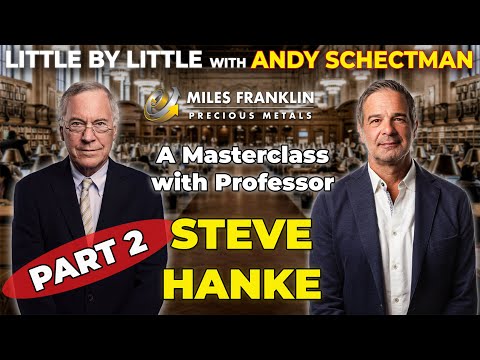
Preview:Part 2 of Andy Schectman's interview with Professor Steve Hanke covers inflation as a monetary phenomenon, hyperinflation definitions and historical case studies, skepticism about AI-driven productivity claims, and the importance of balance sheets in economics. Hanke confirms his bullish gold stance, dismisses US hyperinflation risk, and critiques the Fed's flawed model. The conversation closes with Hanke promoting his Twitter account (@steve_hanke) and a warm exchange between host and guest.
Preview:Professor Steve Hanke makes the case that the money supply is the single most important — and most ignored — variable in markets. He argues that M2 is growing anemically (3.9% vs. his "golden growth rate" of ~6%), that inflation is baked-in to fall to ~2% or below due to 12–24 month lags, and that the Fed should stop quantitative tightening and lower rates. The conversation turns to gold: Andy Schachtman presents data suggesting the LBMA is critically short of deliverable physical metal, which Hanke initially doubted but ultimately found compelling, tying the shift to a collapse of trust driven by pervasive US/EU sanctions. Hanke endorses Judy Shelton's proposal for 50-year gold-redeemable Treasuries and expects it to reach Trump's desk.
Preview:Steve Hanke argues that Trump's tariff policy misunderstands trade deficits — which are caused by the US fiscal deficit, not foreign unfairness. He doubles down on a 2025 recession call, citing money supply contraction as the dominant force, and sees the Atlanta Fed GDPNow drop to -2.8% as confirmation. He views long bonds as a good trade, is skeptical about the Ukraine minerals deal, and says Russia has effectively won the war — the West just hasn't accepted it. He grades Musk's inflation/deficit comments as broadly correct but imprecise.
Others tracked across the same asset focus or market thesis.
Unlock every transcript this speaker appears in, compare them with your other followed voices, and ask the agent for the bull, bear, and consensus read in one workspace.
Type a question. Create a free agent to send it and keep the answer linked to this speaker.
Your question is preserved across sign-in.
Free. No card. Takes about a minute.