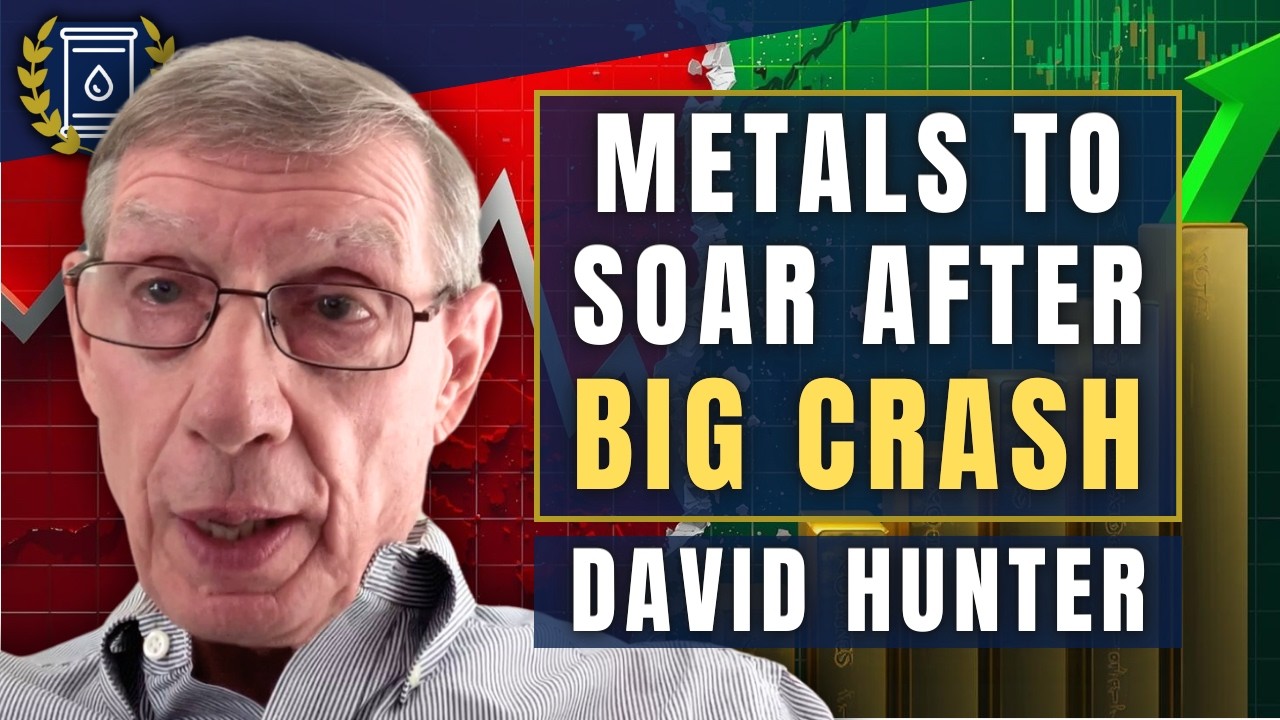
Hunter’s recurring worldview is that modern markets are nearing the end of a long secular bull phase and are vulnerable to a major global bust driven by extreme leverage, debt…
📈 See how David Hunter's thesis changed over time →Preview how this speaker shows up across market transcripts. Unlock the full archive, AI chat, and the version personalized to your watchlist, followed channels, and favorite speakers.
David Hunter appears as a macro/contrarian market forecaster focused on long-wave cycles, leverage, and sentiment. In the supplied material he repeatedly discusses precious metals, equities, debt, and global systemic risk rather than sector-specific fundamentals. He frames markets in cycle terms, often using technical and sentiment cues to argue that corrections are setting up larger moves. He also stresses caution around leverage and emphasizes that timing is hard, even when he has strong directional conviction.
Hunter’s recurring worldview is that modern markets are nearing the end of a long secular bull phase and are vulnerable to a major global bust driven by extreme leverage, debt, derivatives, and policy distortion. He expects a final speculative melt-up or parabolic stage in risk assets and hard assets before a violent downturn. He is structurally bullish on gold, silver, and other tangible assets as protections against fiat debasement, but he also warns those same assets could see very large post-peak drawdowns once the cycle turns. His broader view is deeply contrarian: sentiment, momentum, and crowd positioning matter more to his short-term framing than consensus narratives about inflation, Fed policy, or conventional valuation.
Every analyzed appearance we have for this speaker, newest first. Open any transcript preview to read the underlying transcript.
Preview:David Hunter, a veteran macro strategist, lays out a high-conviction melt-up thesis for gold and silver: gold to $7,000/oz and silver to $200/oz this cycle, driven by a final speculative blow-off before a global bust. He sees silver's recent 5.5-month correction from $122 to ~$56 as having purged excess speculation, setting up an even steeper parabolic leg. Beyond the bust, he has a structural $20,000 gold and $1,000 silver target for the next cycle, fueled by $20T in Fed money-printing and 25% inflation. He is skeptical of a pre-bust gold revaluation, sees bonds bottoming at a 3-year low, and views new Fed chair Kevin Warsh favorably as a long-term inflation hawk.
Preview:David Hunter discusses his updated price targets for gold ($7,000) and silver ($200), maintaining conviction despite a recent correction that broke key support levels. He attributes the sell-off to technical momentum, stop-losses, and a temporary dollar breakout rather than fundamental deterioration. Hunter sees the current low as a likely capitulation bottom and remains bullish on copper ($8 target). He also analyzes new Fed Chair Warsh's monetarist stance, arguing the market is overreacting to hawkish rhetoric, and warns that central bank reluctance to ease quickly will amplify a coming global bust larger than 2008.
Preview:David Hunter presents a deeply bearish macro thesis: we're approaching the end of a 40+ year secular bull market and disinflation cycle. He predicts an 80% peak-to-trough bear market and a "global bust" — a deflationary economic/financial crisis worse than 2008-2009 but not a full depression. His catalyst is extreme systemic leverage (debt + derivatives), with private credit as the "subprime of this cycle." Near-term, he sees one more bullish leg fueled by institutional hedging unwinding (the "wall of worry" is still intact), with July looking strong. When the crisis hits, he believes central banks will eventually print massively — Fed balance sheet potentially expanding to $30 trillion — but only after a "free-falling" period. Timing: top could come by late 2026 or sometime in 2027.
Preview:David Hunter, a veteran macro strategist and self-described contrarian, reiterates his ultra-bullish secular market thesis: the S&P 500 is headed to 10,000, NASDAQ to 36,000, Russell 2000 to 4,000, and the Dow to 67,000. He argues the bull market that began in August 1982 is entering its final parabolic blowoff phase, fueled by resilient earnings, broadening participation beyond tech, and eventual bond market recovery. He acknowledges AI/semiconductor stocks are "up on stilts" and warns of an eventual unwinding from double/triple ordering in chips, but says "we're not there yet." Near-term, he expects a strong July-August rally as institutional investors capitulate into bullishness.
Preview:David Hunter (Contrarian Macro Advisors) lays out his super-cycle thesis: markets are near the final top of a secular bull run that began in 1982, to be followed by an 80% S&P bear market and global bust in the next year, then a massive central-bank money-printing response (Fed balance sheet to ~$30T), a sharp but temporary cyclical rebound, and ultimately a multi-decade secular bear market driven by runaway inflation (25%+) that destroys the fiat system by the mid-2030s. Near-term, he is contrarian bullish into July, citing record hedge-fund shorts as fuel for one more advance.
Preview:David Hunter, a veteran macro strategist and self-described contrarian, lays out his bull case that the secular bull market since 1982 is entering its final parabolic blow-off phase. He sees no near-term top, expects a strong July-August rally, and maintains aggressive year-end targets: S&P 500 at 10,000, NASDAQ at 36,000, Russell at 4,000, and Dow at 67,000. He argues the rally is fundamentally driven by earnings — particularly in semiconductors — but warns that once the parabolic move exhausts, a severe unwind will follow. The conversation is intercut with paid sponsor segments about silver premiums, mining stocks, precious metals seasonality, and the yen carry trade.
Preview:David Hunter argues the recent selloff in gold and silver is likely a capitulation-style break rather than the start of a larger top. He stays bullish on gold, silver, copper, and even bonds, while also warning that the bigger macro endgame could still be a global bust that eventually forces aggressive policy easing.
Preview:David Hunter argues the market is late-cycle but not yet at the top: he expects a final parabolic push in equities and still sees major upside in select areas before a reversal. He is especially focused on sentiment, leverage, passive flows, and the risk that investors will be trapped by a fast downside once the tape turns.
Preview:David Hunter lays out a highly bearish near-term macro view: he thinks the cycle ends this year, a deflationary bust could hit first, unemployment could reach double digits, and broad markets could fall sharply before policymakers respond with massive QE and fiscal stimulus. He then flips to a longer-run inflationary rebound, arguing the post-bust world becomes commodity-led, with oil, copper, natural gas, steel, and silver potentially rising far beyond today’s levels.
Preview:David Hunter lays out an extreme macro call: a parabolic melt-up in equities (S&P 10,000, NASDAQ 36,000) and precious metals (gold $7,000, silver $200) over the next few months, followed by a global bust in 2027 that will dwarf 2008-09. He argues inflation will roll over with oil heading to $60 and eventually $30, rates will follow the bond market down, and the Fed will be forced to expand its balance sheet once the bust hits. Miners (GDXJ $250, SILJ $90) are expected to triple or more. The counterintuitive thesis is maximum bullishness near-term paired with maximum bearishness longer-term.
Preview:David Hunter argues that precious metals are setting up for a powerful continuation higher after a long consolidation, with silver and gold potentially rising sharply this summer and into the fall. He pairs that bullish metals call with a much darker macro view: leveraged fragility, policy error, and overseas banking stress could trigger a fast, broad bust later on, including severe declines in equities and a violent disinflation-to-inflation/debt reset cycle.
Preview:The video argues that gold and silver are in a major inflection point, with physical demand, central bank buying, and leverage in paper markets creating the setup for much higher prices. Andrew Maguire and David Hunter both lean very bullish, with Hunter raising targets to $7,000 gold and $200 silver and saying those levels could be reached by late summer or at least this year.
Preview:David Hunter presents an ultra-bullish near-term thesis: gold to $7,000 and silver to $200 by summer/Labor Day, with the S&P hitting 10,000, in what he calls the "parabolic melt-up stage" of a 44-year secular bull market. He then expects a global bust akin to 2008-09, with an 80% equity bear market and precious metals corrections of 50%+. Longer-term, he targets gold at $20,000 and silver at $1,000 by the early 2030s. He frames the recent metals consolidation as normal and sees an imminent upside breakout, with Iran resolution as a potential catalyst.
Preview:David Hunter argues that gold and silver are in a bigger monetary bull market that has merely paused after a sharp run-up. He says gold’s near-term target is $7,000, silver’s is $200, and both could later suffer a major bust-like correction before much larger long-term targets emerge.
Preview:The speaker argues that silver and gold are late-cycle parabolic trades that could still run much higher before a violent bust. He expects silver to overshoot on momentum and institutional chasing, while gold remains more stable but still vulnerable to a major post-peak drawdown.
Preview:The speaker argues that the recent oil spike was driven mainly by Iran-related disruption and could reverse quickly if a real agreement opens the Strait and restores flows. From there, he extends the same disinflation logic to yields, saying the 10-year could fall back toward 4% quickly and even to 3% or below by year-end if oil rolls over.
Preview:David Hunter argues silver is late in a parabolic advance and could still rally into the summer before a potentially violent top and broader bust. He sees the move as driven more by sentiment, leverage, and skepticism turning into buying than by any single near-term catalyst, though Iran-related headlines could affect timing.
Preview:David Hunter argues silver and gold are in a late-cycle blow-off that could continue sharply higher before a global bust hits most assets. He sees silver potentially running from $100 toward $180–$200, gold around $6,800 pre-bust, then both suffering large drawdowns afterward before a much larger long-term gold opportunity in the early 2030s.
Preview:David Hunter argues the market is in a late-cycle meltup driven mainly by sentiment and positioning, not broad monetary ease, with near-term upside in equities and metals before an eventual severe global bust. Jeremy Saver frames the setup around gold, silver, oil, bonds, Iran, Nvidia, and tightening financial conditions, while Hunter says the decisive risks are leverage, policy error, and a likely recession leading into a much bigger unwind.
Preview:David Hunter argues that equities are near a late-cycle top, with a possible high in coming months and a broader selloff later that could become an 80% bear market. He is very bullish on gold, silver, and miners over the next few months, but sees those metals as temporarily behaving like risk-on trades rather than classic safe havens. His bigger thesis is deflationary bust first, then a massive QE response and eventually a severe inflation cycle.
Preview:David Hunter argues the market is still in the final melt-up phase of a long secular bull market, with further upside in equities, metals, and selected cyclicals before a later bust. His most immediate catalyst is a possible resolution of the Iran conflict, which he thinks could push oil lower, ease inflation fears, and fuel one last strong leg higher in stocks and metals.
Preview:David Hunter argues that bonds and precious metals are at the start of a major secular turning point. He expects a near-term move lower in bond yields, a powerful extension higher in gold and silver, and then, after a bust, a violent liquidation followed by an inflationary commodities super-cycle.
Preview:David Hunter argues the market is in the early stage of a final parabolic melt-up in stocks and commodities, driven by skeptical positioning, lower rates, a weaker dollar, and any easing in Iran/oil तनाव. He then flips to a much darker long-term view: a global debt bust, forced central-bank money printing, and a later inflation/commodity surge after an 80%+ equity decline.
Preview:David Hunter argues the precious-metals bull market has only paused, not ended, and that gold/silver may soon resume a very fast move higher before a later, much larger bust. He pairs that with a broader macro warning: inflation and rising rates could compress equity valuations, favor commodities and commodity-linked stocks, and eventually mark a long secular top in passive index investing.
Preview:David Hunter argues the market is in the early phase of a final parabolic melt-up, with major U.S. equity indexes, gold, silver, and risk assets set to run much higher over the next few months, helped by improving sentiment, lower oil, lower rates, and eventual resolution around Iran.
Preview:David Hunter argues that a major market bust is coming, but that the next move may still be a strong, parabolic upside leg in gold and silver before the downturn hits. He expects inflation to stay contained or roll over this summer unless Iran causes a temporary oil shock, and he sees rates, metals, and stocks as tied to the same macro/credit setup.
Preview:David Hunter argues that markets are in a late-cycle melt-up, with higher targets still in play for equities and metals before an eventual global bust. He expects near-term resilience in the U.S. economy and bond market, but says underlying weakness is building through private credit stress, uneven consumer demand, rising oil prices from the Iran conflict, and broader credit deterioration.
Preview:David Hunter argues the market is in a late-cycle parabolic melt-up that can still extend into summer, with the S&P 500 potentially reaching 9,500 and precious metals making another major leg higher after a correction. Beneath the near-term volatility, he sees a mixed but still resilient U.S. economy, an eventual rollover in rates and inflation, and ultimately a global bust that would force aggressive monetary easing.
Preview:David Hunter argues the market is entering a late-cycle blow-off phase that could still extend higher across stocks, bonds, and metals before a bust and recession hit. His core message is contrarian: the rally is broadening beyond Mag 7, the Russell 2000 could reach 3,000, 10-year yields could fall below 4% and even toward 2.5%-3%, and the eventual crisis will force massive money printing—but likely only after the downturn is already underway.
Preview:David Hunter argues that silver, gold, miners, equities, and oil are all in a late-cycle, sentiment-driven setup tied heavily to the Iran conflict and ceasefire negotiations. He thinks the market is looking through the worst-case war narrative, sees the current pullback as nervousness rather than trend failure, and expects new highs in gold and silver this quarter and a major melt-up in the S&P before a larger top later this summer.
Preview:David Hunter argues that the Iran war shock has reinforced, not broken, his bullish setup: it rebuilt a "wall of worry" that can fuel a final melt-up in equities, metals, and even bonds before a later global bust. He thinks oil has likely peaked on the war scare, gold and silver are set for new highs this quarter, the S&P can still run toward 9,500, and the real downturn likely starts late this year or in 2027.
Preview:David Hunter argues the metals bull market is in its final stretch over the next 5-8 months, with a sharp upside move still ahead before a large bust-driven consolidation. He also sees U.S. equities, bonds, and commodities all participating in a broader cycle shift, with the near-term Middle East shock creating volatility but not altering his view that the second quarter could be a historic rally window.
Preview:David Hunter argues the market is heading into a late-cycle meltup before a severe bust. He expects falling inflation and rates to support one more strong rally in equities, bonds, metals, and commodities, while warning that a later deflationary downturn could be far worse than 2008 and eventually force massive money printing.
Preview:David Hunter lays out a wildly bullish near-term call for gold ($6,800) and silver ($180 by summer 2026), alongside big targets for mining ETFs (GDX 180, GDXJ 250, SIL 220, SILJ 90) and copper ($8 pre-bust). He frames this within a much darker longer-term thesis: an 80% stock market crash ("the bust"), 25% inflation, and eventual financial system collapse by the mid-2030s, followed by an inflationary commodity supercycle — copper to $20+, oil to $500. He is not a dollar-reset imminentist; he sees DXY falling to 82 first, then surging to 120 during the bust.
Preview:Lobo Tiggre and the video’s framing argue that gold and silver remain in a powerful longer-cycle bull market, with the recent pullback viewed as a reset rather than a top. Tiggre is extremely bullish on higher price targets—gold to $6,800 near term and ultimately much higher, silver to $180 in 3–6 months and $500 later—while treating bullion as savings and mining stocks as a separate, more selective levered trade.
Preview:David Hunter argues the market is finishing a consolidation and should continue higher for a few months before a major bust later this year, with small caps and tech still participating. He remains extremely bullish on gold, silver, miners, and commodities into the bust-and-reinflation sequence, while warning that the eventual downside could be historic.
Preview:David Hunter argues that silver is in a parabolic move and can still overshoot much higher, while gold has room to keep rising and the broader equity market may be nearing the end of a 43-year secular bull run. He ties the setup to heavy central-bank buying, persistent liquidity, and a massive paper/physical imbalance in silver, but stresses that his timing is target-based rather than calendar-based.
Preview:Michael Oliver (momentum analyst) and David Hunter (macro strategist) present a hyper-bullish precious metals thesis: silver is breaking out and will lead gold, with silver targets of $200 near-term (6 months), $500 in the next cycle, and possibly $1,000 during a coming crisis. Gold targets rise from $5,000 short-term to $20,000 by the early 2030s. Both see an impending equity market bust (a 43-year secular top), after which commodities — led by monetary metals — will dominate. Oliver focuses on momentum breakouts across gold vs. S&P, silver vs. S&P, silver vs. gold, and miners; Hunter adds Fed rate-cut expectations, a bond rally to 3% on the 10-year, and one final surge in housing/biotech before the bust. Both acknowledge a near-term pullback risk but frame it as a buying opportunity.
Preview:David Hunter argues the S&P is in the final, parabolic leg of a 43-year secular bull market, with the S&P potentially reaching 9,500 before a major 2026-era bust. He remains bullish on equities, especially small caps, metals, miners, bonds, and some rate-sensitive sectors, while warning that the bigger setup is a coming global crisis and an eventual 80% equity drawdown.
Preview:David Hunter, a macro strategist, lays out an aggressive final-stage bull thesis: the S&P 500 could reach 9,500 (~40% upside from current levels) within months, gold to $5,000+, and silver to $100. But this is the terminal blow-off of a 43-year secular bull market, and he expects a devastating global bust to follow — potentially an 80% stock market decline — starting sometime in 2026. His tactical play: ride metals and miners for the final leg up, then rotate to Treasuries and cash before the bust. The Fed is a sideshow; the bond market, not the FOMC, drives rates, and he sees the 10-year yield falling toward 3%.
Preview:David Hunter lays out an extreme macro forecast: the S&P 500 could run another ~40% to 9,500 before an 80% crash marks the end of a 43-year secular bull market, followed by a deflationary bust, unprecedented Fed stimulus (~4x 2020 levels), and then a commodity-led inflation cycle pushing gold to $20,000 and silver to $500. He sees gold at $5,000 (possibly conservative) and silver at $100 within months, with miners poised for their biggest 6-month run. Key catalyst watch: a sentiment shift from caution to euphoria signals the top, and a sharp decline in bond yields (10Y to 3%, ultimately 0%) precedes the bust.
Preview:David Hunter, a contrarian macro strategist with 50+ years on Wall Street, tells Liberty and Finance that the recent ~5% S&P pullback has likely bottomed. He projects a 40%+ melt-up to S&P 9,500 by early 2026, gold to $5,000 (possibly conservative), and silver to $100 — all before a global bust he calls the end of a 43-year secular bull market, featuring an ~80% stock crash, then 25% inflation, and a commodity-led next cycle.
Preview:David Hunter presents his long-cycle macro thesis: a parabolic equity melt-up in coming weeks (S&P toward 9,000-10,000), followed by a global bust in 2026 (80% bear market, deflation, financial crisis worse than 2008), then a massive central bank response (~$20T Fed QE, ~$50T globally) that kicks off a secular bull market in precious metals — $20,000 gold and $500 silver by the early 2030s, with hyperinflation to follow by mid-2030s. He advises using treasuries as a bust shelter, rotating into quality miners post-bust, and abandoning passive index/buy-and-hold strategies tied to tech-heavy indexes.
Preview:David Hunter argues the market is in the last, parabolic phase of a 43-year secular bull market, with the S&P potentially reaching 9,500 in the next few months as liquidity, Fed easing, and institutional FOMO broaden the rally beyond tech. But he says this sets up a sharp reversal: a 2026 global bust, much worse than a normal recession, driven by extreme leverage and delayed policy response, followed by deflation first and then a later inflationary/debt-collapse regime.
Preview:David Hunter argues the U.S. stock market is in the late, parabolic stage of a 43-year secular bull market, with a final melt-up still ahead before a severe bust. He is sharply bullish on gold, silver, and miners in the near term, while expecting a post-bust commodity supercycle led by inflation, weak currencies, and higher real-world commodity demand.
Preview:David Hunter argues this is still a late-cycle meltup, not the final top yet: he thinks stocks, gold, and bonds can all keep rising for a while as the Fed starts easing into a weakening economy. His near-term call is for one or more cuts next week, lower yields, and continued upside in gold and silver, but he also warns that the bigger bust likely comes next year and could be worse than 2008.
Preview:David Hunter argues the market is in the final melt-up of a very long secular bull, with a short-term correction likely but much higher highs still ahead before a major bust next year. He is bullish equities, gold, silver and bonds over the near term, then expects a deflationary global credit crisis, aggressive QE, and a sharp reset in risk assets before a later inflationary commodity-led cycle.
Preview:David Hunter argues the rally in equities and precious metals still has more upside before a late-cycle blowoff, while warning that a much larger global bust likely follows. He keeps very bullish near-term targets on the S&P 500, gold, silver, and miners, but frames them as part of a final parabolic leg rather than a durable forever trend.
Preview:David Hunter argues the S&P 500 is in the final, steep stage of a long secular bull market and could run to 8,000 on the S&P, with similarly aggressive upside targets for the NASDAQ, Dow, and Russell before a top later this summer or in the fall. He expects the economy to weaken even as equities keep rising for a while, helped by falling rates, a softer dollar, Fed easing, Trump’s tax/deregulation agenda, and improving investor psychology as skeptics are forced back in.
Preview:David Hunter argues the Trump tariff shock was part of a broader negotiation strategy, not the end of tariffs or trade reform, and says the market’s April selloff likely reset sentiment before a final bull leg higher in equities. He stays constructive on gold, silver, miners, and even sees a major bond-market bottom, while warning that a later global bust could still produce a violent interim selloff across risk assets and metals.
Preview:David Hunter argues the tariff shock is creating near-term recession risk and market turmoil, but not the final “global bust” yet. He thinks the trade war is forcing a messy reset in tariffs and supply chains, rates may have already put in a top, gold and silver are acting well, and oil has broken lower with room for more downside before a later commodity supercycle.
Preview:Andy Shectman interviews David Hunter, who argues that inflation is still trending lower, the economy is fragile, and tariffs are mostly a one-time price bump rather than a durable inflation impulse. His bigger thesis is a sequence: an imminent market melt-up into new highs, followed by a severe deflationary bust, then an aggressive policy response, a commodity super-spike, and much higher inflation later on.
Preview:David Hunter argues the market is still in a tactical rally phase, but that the bigger move is a recession this year followed by a much larger global bust within roughly a year. He expects the Fed and bond market to ease, the dollar to weaken, and gold, silver, and parts of the metals complex to keep rising before the later downturn hits risk assets hard.
Preview:David Hunter argues the recent tariff-driven selloff likely marked a short-term bottom, but it is only a pause inside the final, steep leg of a decades-long secular bull market in U.S. stocks. He expects a powerful bounce in equities, a further surge in gold and silver, then a much larger bust later this year or early next year that could trigger banking stress, aggressive Fed easing, and a broad commodity/inflation cycle afterward.
Others tracked across the same asset focus or market thesis.
Unlock every transcript this speaker appears in, compare them with your other followed voices, and ask the agent for the bull, bear, and consensus read in one workspace.
Type a question. Create a free agent to send it and keep the answer linked to this speaker.
Your question is preserved across sign-in.
Free. No card. Takes about a minute.