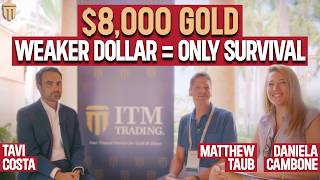
bullish on precious metals and resource market cycles
📈 See how Tavi Costa's thesis changed over time →Preview how this speaker shows up across market transcripts. Unlock the full archive, AI chat, and the version personalized to your watchlist, followed channels, and favorite speakers.
Tavi Costa is a macro/commodities strategist and CEO/founder associated with Azuria/Azura Capital, with a strong public presence on X (@TaviCosta) and in metals-focused interviews. In the supplied material he comes across as chart-driven and highly active in public commentary, often using market data, relative-performance charts, and reserve-asset comparisons to frame his views. He repeatedly emphasizes central bank gold buying, mining equities, copper, silver, and the interaction between rates, the dollar, and real assets.
Costa’s recurring worldview is broadly hard-asset bullish and structurally macro-driven. He sees the world as being shaped by persistent fiscal and trade imbalances, high debt burdens, and a dollar system that ultimately requires a weaker dollar and lower real rates to remain workable. He argues that gold and silver are in a long-term accumulation phase, that central banks are structurally supporting gold demand, and that miners can be attractive because fundamentals can improve even when spot prices are volatile. He is also constructive on copper because of electrification, data centers, onshoring, and AI-related infrastructure. More generally, he favors owning productive hard assets and selects investments through a first-principles lens of profitability, balance-sheet resilience, and long-duration scarcity. He also appears to think the precious-metals cycle has significant room left, though short-term timing remains uncertain.
Every analyzed appearance we have for this speaker, newest first. Open any transcript preview to read the underlying transcript.
Preview:Tavi Costa argues that the market is underestimating inflation persistence, fiscal stress, and the constraints on the Fed, and that those conditions support owning gold, silver, copper, miners, and some energy exposure. He says the recent selloff in gold and mining stocks is an opportunity, not a thesis break, and that the biggest strategic rotation may be toward hard assets and select Latin American markets over the next several years.
Preview:A roundtable-style junior mining discussion centered on gold, silver, copper, uranium, and select royalty/development names. The speakers argue that the recent pullback in precious-metals equities has created a better entry point for quality projects, especially cash-rich developers, royalty companies, and permitted assets in safe jurisdictions, while the long-term bull case remains supported by currency debasement, central-bank buying, and commodity scarcity.
Preview:Tavi Costa argues that gold and silver are in an unusually oversold, near-capitulation condition and that the recent selloff is more likely a buying opportunity than a broken thesis. He says the market is overreacting to two things he thinks are unsustainable: geopolitical tension and the idea of a new hiking cycle, while the U.S. dollar looks stretched and likely to roll over. He is more constructive on miners than on the metals themselves, saying many cash flows and margins remain strong and that institutional capital is starting to notice.
Preview:Tavi Costa (Azurio Capital) joins Wall Street Bullion to discuss gold and silver. He argues we remain in a secular bull market for precious metals driven by structural central bank buying, unresolvable fiscal imbalances, and the unsustainability of rising real rates and war. He sees the current oversold conditions — ETF outflows, negative sentiment, real yields at 2-year highs — as an accumulation opportunity, not a trend reversal. He is personally deploying cash into gold. On silver, he views the 53% drop in ETF holdings as reminiscent of 2020 and a potential window. He flags that suppression of rates and a weaker dollar are the defining macro shifts of the next decade, favoring gold, silver, copper, miners, and emerging markets.
Preview:Tavi Costa argues the dollar and interest rate curve are poised for a major reversal after overshooting on geopolitical fears, which will act as a powerful tailwind for precious metals and commodities. He sees gold and silver near a bottoming process, expects silver to reach triple digits within 3 years, and views oil's pullback as a digestion pause within a broader commodity super-cycle. The Fed is "bluffing" on hawkishness — the US fiscal position makes a sustained tightening cycle unsustainable.
Preview:Tavi Costa argues gold's decline from $5,600 to $4,000 is a steep but normal correction within an ongoing secular bull market. He frames the pullback as an opportunity, citing structural demand from central banks, decades of underinvestment in mining supply, and AI/electrification-driven industrial demand for silver and copper. He sees operational leverage in miners as underappreciated and expects real assets to reprice higher once real rates and dollar strength reverse.
Preview:Tavi Costa of Azura Capital argues that the US must weaken the dollar to survive its debt burden, with ~4-5% of GDP going to debt service. He sees gold reaching $8,000 driven by Treasury/fiscal dynamics, expects the Fed to eventually change its inflation calculation rather than hike rates, and views the current pullback in gold/silver miners and royalty companies as a rare buying window comparable to 2008.
Preview:Tavi Costa argues gold’s pullback is mainly a positioning/sentiment reset, not a broken thesis, and says the market may be near a bottom after the sharpest oversold move since 2008. He is also bullish on gold miners, silver, and copper over time, while expecting dollar strength to reverse and inflation to remain structurally sticky.
Preview:Tavi Costa, interviewed at the Rule Symposium, sees the current selloff in gold (down 25-30%) and mining stocks (producers down 40-50%) as a rare accumulation opportunity within a secular bull market. He's most bullish on gold, silver, copper, and energy — with natural gas singled out as the only near-term solution for data-center power demand. He's skeptical of critical minerals, calling the institutional rush into rare earths and tungsten a "disease" that echoes the lithium bubble. His three-pillar framework: metals & mining, energy, and Latin America.
Preview:Tavi Costa argues that the recent dollar strength is temporary, that the dollar must weaken over time for the system to remain stable, and that gold remains in a long-term bull market despite the recent pullback. He sees central-bank gold accumulation, deglobalization, high debt, and eventual Fed easing as the main drivers, with silver and copper as complementary opportunities and Latin America/emerging markets as another major area of interest.
Preview:Tavi Costa, CEO of Metalla Royalty, makes a deeply contrarian case: mining is a terrible business in execution but an extraordinary business in economics — legacy, irreplaceable, and at current metal prices it generates margins exceeding big tech. He frames this moment as "the rebirth of mining" driven by automation potential over 10-15 years, argues for a first-principles focus on gold/silver/copper over frothy critical-mineral narratives, and warns that capital misallocation into rare earths is a mistake when copper faces a massive supply deficit. Management quality and asset quality are everything; the industry will consolidate around those who get capital allocation timing right.
Preview:Tavi Costa argues that precious metals miners are "printing money" at current metal prices, yet their stock prices haven't reflected unprecedented fundamentals. The macro framework hinges on two structural US problems — fiscal deficits compounded by high interest rates, and trade balance deficits — both pointing toward lower rates and a weaker dollar. On supply/demand, structural demand for copper, gold, and silver continues building (AI infrastructure, electrification, central bank buying, onshoring), while supply remains constrained by 15-year mine development timelines. Costa frames high-quality resource deposits as irreplicable "moats" that AI cannot disrupt, and treats sell-offs as moments to refine micro-level company analysis rather than panic.
Preview:Tavi Costa argues that the recent selloff in gold, silver, miners, and some energy names is a normal correction inside a larger secular bull market, not the end of the trend. He says fundamentals remain strong, valuations have become more attractive, and investors should keep accumulating high-quality names gradually rather than trying to time the bottom.
Preview:Tavi Costa argues the silver and precious-metals selloff is mostly a short-term, overdone reaction to a hawkish Fed first press conference, not a structural change in the bullish setup. He says the dollar breakout is the main near-term headwind, but miners, copper, yields, inflation expectations, and emerging markets are not confirming a broad risk-off break.
Preview:Tavi Costa argues the AI buildout is not just a tech story but a major driver of a broader commodities and hard-assets super-cycle because it requires vast amounts of electricity, infrastructure, and mined materials. He thinks markets are still underpricing major miners and select metals—especially copper, silver, gold, zinc, and nickel—despite worsening reserve depletion, underinvestment, and rising strategic importance. He also gives several specific names he likes and says the recent pullback is painful but likely a buying opportunity rather than the end of the thesis.
Preview:Tavi Costa, founder of Aurora Capital, joins Ian Spievac on tastylive to discuss the sharp gold sell-off — now at a 3-month low. Costa maintains an unshaken bullish conviction: the pullback is a buying opportunity driven by an overblown hawkish-Fed narrative, not a change in the structural thesis. He is actively accumulating senior gold miners (NEM, Hecla, Agnico Eagle) and sees Brazil as another green-light opportunity, with political turmoil creating a discount disconnected from fundamentals.
Preview:Tavi Costa argues that the macro setup is increasingly supportive of hard assets: debt burdens are forcing rate suppression, the dollar should weaken, and that backdrop should keep favoring gold, silver, copper, and selective miners. He sees recent pullbacks in mining and EM assets as normal digestion rather than thesis breaks, while warning that politics, jurisdiction risk, and government intervention are now central variables investors must price.
Preview:Tavi Costa argues the market is misreading the bond-yield move as a 2021-style inflation scare and that the bigger issue is debt-service pressure, which will force the Fed toward easier policy within about 12 months. He says that combination of easing conditions and still-strong inflation would be bullish for hard assets, gold, mining stocks, copper, energy, and selected emerging markets, especially Latin America.
Preview:Interview with Tavi Costa arguing that silver, gold, and mining stocks remain structurally bullish despite sharp volatility. His core view is that rising debt costs and limited policy flexibility will eventually force easier monetary policy, which he thinks supports precious metals and miners.
Preview:Tavi Costa argues copper is entering a price-discovery phase and remains very cheap versus gold despite all-time highs, while broader hard assets, natural gas, and agricultural commodities should benefit from debt, inflation, and supply constraints.
Preview:Tavi Costa argues the U.S. is in a debt trap that will be resolved by letting inflation run hotter, not by maintaining high rates. He says the Fed is understating inflation, rates are too high relative to debt servicing capacity, and investors should own hard assets—especially gold, miners, and select commodities—as the monetary regime shifts.
Preview:Tavi Costa argues the market is underestimating a supply-driven inflation regime that central banks cannot easily suppress, making hard assets, commodities, energy, select emerging markets, and especially mining equities attractive. He frames the current drawdown in gold and miners as a buying opportunity within an early-innings secular bull market, not a cycle top.
Preview:Tavi Costa argues the recent gold selloff was not a true liquidation event and sees it as a buying opportunity within a much larger bullish gold thesis. He pairs that with a contrarian macro book: long-term U.S. Treasuries, Chinese equities via options, and European banks, while also emphasizing gold, miners, energy, Latin America, and Brazil as broader themes tied to dollar weakness, deglobalization, and leverage in the system.
Preview:Tavi Costa lays out a secular bull case for hard assets — gold, silver, copper, oil, and mining equities — rooted in unsustainable US fiscal deficits that he argues can only be resolved by forcing interest rates lower, which debases the currency. He sees AI's infrastructure build-out as a 10-year demand driver for materials, believes copper is poised for a major near-term move, and expects Latin America to capture a growing share of global mining capital. Costa is launching his own fund focused on metals/mining, energy, and LatAm.
Preview:Tavi Costa argues that commodities are at an inflection point, with gold already moving but miners, energy, copper, and agriculture still lagging and likely to catch up. He frames the setup as a long-cycle rotation driven by structural gold demand, underinvestment in exploration, a weakening dollar, and eventually lower rates.
Preview:Tavi Costa argues the Iran war is a market catalyst but not the core thesis: he thinks the bigger story is a long cycle of higher gold, silver, energy, and commodities, driven by debt, deglobalization, weaker real purchasing power, and a likely need for lower rates and a softer dollar.
Preview:Tavi Costa argues precious metals, especially silver and gold, are in an elevated-price regime driven by strong demand, weak supply response, and a likely weakening U.S. dollar. He says mining equities are still massively under-owned relative to history and that many miners now generate tech-like margins, making the space attractive despite volatility.
Preview:Tavi Costa argues the commodity supercycle is still in its early innings, with the biggest opportunity in mining equities, plus energy and selective Latin America exposure. He says institutions are only now waking up to years of underinvestment, while AI data centers, reindustrialization, infrastructure rebuilds, and government strategic buying are creating a major demand tailwind against tight supply and weak discovery pipelines.
Preview:Tavi Costa argues the US dollar is in a structural downtrend driven less by inflation or growth data than by debt-service pressure, forcing lower US rates and helping push capital toward gold, silver, miners, energy, and emerging markets. He says the precious-metals move is not finished, but the biggest near-term dislocation is in mining equities and the next major capital rotation should favor companies with scarce assets, growth optionality, and M&A appeal.
Preview:Darrell Thomas interviews Tavi Costa of Azuria Capital about his 2026 outlook on gold, silver, copper, energy, the dollar, and portfolio rotation. Costa argues that the bull market in hard assets is still early, driven by central-bank buying, massive global debt burdens, likely dollar weakness, and a multi-year shift away from expensive U.S. financial assets into commodities, mining, and selected energy exposure.
Preview:Tavi Costa argues 2026 is setting up as a strong year for hard assets, especially energy and mining, because commodity markets are still under-owned, supply response is constrained, and capital discipline has left the sector short of reserves and new discoveries. He sees mining equities as still cheap relative to metal prices, but says the bigger medium-term catalyst is M&A and a broader rotation from financial assets into physical assets as debt burdens, inflation pressure, and policy constraints intensify.
Preview:Tavi Costa argues the US is at a critical debt threshold — interest payments approaching 5% of GDP — which structurally forces rates toward zero regardless of inflation. This monetary debasement path drives his ultra-bullish precious metals thesis: silver to triple digits, gold to double or triple. He highlights a historic supply anomaly: despite all-time high prices, global mining production is still declining with no capital spending response, signaling physical scarcity rather than speculative froth. His 10-15 year conviction is hard assets; he warns disciplined gold investors risk selling too early when prices reach "banana stage" levels.
Preview:Tavi Costa of Crescat Capital lays out a strongly bullish case for silver, gold, mining equities, and emerging markets. He argues silver's cup-and-handle breakout above prior highs will be "monumental," driven by gold's lead and a secular precious metals cycle. He sees a weakening US dollar — fueled by a twin deficit problem — as the key macro driver, and positions Latin American emerging markets as the next asymmetric opportunity. Near-term, he warns of equity market divergences but views any correction as a buying opportunity.
Preview:Tavi Costa argues that gold’s surge is part of a deeper monetary reset driven by debt, deglobalization, fiscal dominance, and central-bank reserve diversification away from Treasuries. He extends that thesis to miners and especially silver, saying silver is still priced too cheaply, could be revalued dramatically if monetary demand shows up, and may be the highest-conviction opportunity in the hard-asset complex right now.
Preview:Tavi Costa argues the market is entering an inflationary, dollar-down cycle that should favor hard assets, miners, energy, and emerging markets. He says the mining sector is early in a bull phase—not a bubble—while tech is the frothy, crowded part of the market, and he expects the Fed to cut “in a big way” into 2026 even if the next meeting is uncertain.
Preview:Tavi Costa of Crescat Capital presents a strongly bullish macro thesis centered on commodities, gold, and gold miners. He argues that commodities are diverging from still-muted inflation expectations and will eventually pull inflation higher, that central banks are structurally rebalancing from Treasuries into gold (first time since 1996), and that the gold mining sector has entered a 2-3 year cycle where miners will outperform bullion. His biggest concern is how Mag7 companies will finance the AI arms race, predicting they will take on significant debt and abandon shareholder-friendly policies — a shift he thinks markets will not take well.
Preview:Tavi Costa argues gold is consolidating after a strong run, but the bigger move is in the next layer of precious metals and hard assets: silver, junior miners, emerging markets, and eventually copper. His core macro thesis is that U.S. twin deficits, a likely dollar decline, and political pressure on the Fed will eventually push rates lower and support a broader reflationary trade.
Preview:Tavi Costa argues silver is in the early stages of a major bull market and could eventually reach triple digits, driven by a lagging catch-up to gold, a weak dollar backdrop, rising industrial demand, and structural supply constraints. He also broadens the bullish view to copper, zinc, and select mining equities, while warning that inflation and policy surprises could create near-term market volatility.
Preview:Tavi Costa of Crescat Capital discusses the alarming drop in US gold reserves relative to government debt (now ~2%, down from 40% pre-WWII and 17% in the 1970s). He argues this signals gold is massively undervalued and that the US will eventually be forced to revalue gold or acquire more — either path would drive prices dramatically higher. He sees a multi-year dollar decline ahead, driven by unsustainable interest payments (4–5% of GDP) and the need to suppress rates. He also highlights an AI infrastructure arms race between the US and China that could triple or quadruple construction spending, benefiting raw material producers.
Preview:Tavi Costa lays out a strongly bullish, long-duration thesis on hard assets, especially gold, silver, copper, zinc, and oil, anchored in weaker-dollar/lower-rate expectations, underinvestment in resources, and a coming infrastructure-heavy, more inflationary buildout. He also favors emerging markets, particularly Latin America and Brazil, while remaining far less negative on China than in the past.
Preview:Kai Hoffman interviews Tavi Costa about why he expects the U.S. to lean toward lower rates and a weaker dollar because the current debt, fiscal, and current-account burdens look unsustainable. Costa argues this macro setup favors non-U.S. assets, commodities, and parts of the mining complex, and he sees the Department of Defense’s MP Materials deal as a sign the U.S. is becoming more directly involved in strategic resource supply chains.
Preview:Tavi Costa argues that the dollar is entering a multi-year downcycle and that this should broadly favor hard assets, especially gold, silver, miners, and selected emerging markets. His strongest near-term expression is silver: he thinks history, central-bank behavior, deglobalization, and rising industrial demand make silver’s relative underperformance to gold likely to reverse.
Preview:Tavi Costa of Crescat Capital argues gold's rally is not a technical-trade story but a structural monetary realignment driven by sovereign debt burdens. He contends the US Treasury is actually incentivized to see gold rise — via revaluation of its reserves to expand the TGA account and buy back Treasuries. Silver and junior miners remain deeply undervalued relative to gold, and he sees history suggesting gold could reach $20,000+/oz if reserves returned to 1940s–70s ratios relative to debt. On China, he takes a contrarian view: their gold buying is real but constrained by currency pressures. The interview also touches on Trump's tariff strategy and the likelihood of a prolonged US-China standoff.
Preview:Tavi Costa of Crescat Capital argues gold's rally is healthy and not ending on overbought signals, silver is massively undervalued relative to gold with the gold/silver ratio breaking below 100 for the first time since a pattern resembling 2008, and the biggest macro opportunity is a halving of 2-year Treasury yields within 6-12 months as recession risk forces the Fed's hand. He advocates a value-oriented, venture-capital-style approach to junior mining equities as the most undervalued part of the market.
Preview:Tavi Costa argues that junk-bond spreads, weak breadth, and stubborn inflation are warning signs that the market may be underpricing a larger volatility event. He thinks the Fed will stay tight for now, which could force two-year yields lower later as recession odds rise, while also reinforcing a weaker-dollar, pro-gold, and pro-non-US-assets setup.
Preview:Tavi Costa of Crescat Capital lays out a multi-layered bullish thesis centered on gold, silver, miners, and emerging markets. He argues the US is in a "chicken and egg" trap where it must lower rates to manage debt, which will weaken the dollar — the next catalyst for gold. Silver is poised for a major breakout on a quarterly close at record levels with the gold-to-silver ratio near 90. Miners are generating record free cash flow yet remain historically cheap relative to tech. He also flags zinc as an asymmetric opportunity and is extremely bullish on South America.
Preview:Tavi Costa argues that the U.S. is entering a monetary reset in which gold matters again, the dollar likely has to weaken, and silver is preparing to catch up in a major way. He sees the setup as supportive for gold, silver, miners, and other hard assets, with the immediate focus on watching dollar weakness rather than daily price swings in silver.
Preview:Tavi Costa argues gold is still in the early stages of a larger monetary revaluation, with upside driven by central-bank buying, dollar weakness, and a possible shift in U.S. policy. He is also bullish on silver, gold miners, exploration names, and resource-linked markets as capital rotates away from expensive U.S. equities and tech.
Preview:Tavi Costa argues the U.S. dollar is extremely overvalued and likely entering a material decline, which would ease global financial conditions, support commodities and precious metals, and hurt the relative leadership of expensive U.S. stocks. He is especially bullish on gold, silver, mining stocks, and selected non-U.S. assets, while Adam Taggart and the New Harbor Financial team agree the setup is increasingly favorable for non-U.S. equities, metals, and duration, though they caution that a true major-market-top regime still needs more recession confirmation.
Preview:Tavi Costa (Crescat Capital) argues gold's rally to new all-time highs is driven by leaks about a potential US gold revaluation on the Fed/Treasury balance sheet, alongside Western investors finally joining Eastern central bank buying. He is exceptionally bullish on silver, citing a still-elevated gold-to-silver ratio (~90), tight supply from Mexico and Peru, and surging solar/AI-driven demand that could consume five years of US silver production. He sees a generational turning point for miners as gold prices have risen ~$1,000/oz while costs rose only ~$200/oz, creating massive margin expansion. On macro, he expects a secular dollar downturn that would benefit emerging markets, commodities, and natural resources.
Others tracked across the same asset focus or market thesis.
Unlock every transcript this speaker appears in, compare them with your other followed voices, and ask the agent for the bull, bear, and consensus read in one workspace.
Type a question. Create a free agent to send it and keep the answer linked to this speaker.
Your question is preserved across sign-in.
Free. No card. Takes about a minute.